



ACRO Innovation Day: Advancements in Biologic Drug Development & Translational Science


Overview
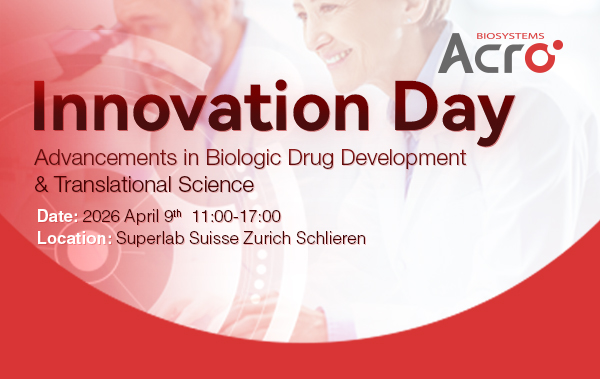
Join us at ACRO Innovation Day: Advancements in Biologic Drug Development & Translational Science on 9th April!
This gathering brings together leading scientists, industry innovators, and translational research experts to explore emerging technologies, evolving regulatory landscapes, and new strategies accelerating the path from discovery to clinic. From cutting‑edge development platforms to real‑world case studies, ACRO Innovation Day offers a focused, high‑value program designed to spark collaboration and inspire new thinking. Whether you work in R&D, CMC, translational science, or clinical development, this event provides a unique opportunity to connect with peers and gain insights that can drive your next wave of innovation.
Seats are limited - Register now!
Conference Rooms:
Superlab Suisse Zürich Schlieren
Zürcherstrasse 39D
8952 Schlieren, Zurich
Switzerland
Date & Time:2026 April 9th 11:00-17:00 CET
Food and drinks will be served on-site.
Speakers

Jenny Ann Prange, PhD
Head of Project Management
Wyss Zurich, Regenerative Medicine Technologies Platform, University of Zurich
Speaker Bio:
Jenny Ann Prange, Head of Project Management at Wyss Zurich’s Regenerative Medicine Technologies Platform at the University of Zurich and Co‑founder of MUVON Therapeutics, is a biotechnologist who has passionately established and led the production of MUVON’s autologous cell therapy since 2017. In 2025, the company successfully completed its Phase II clinical trial, after which she joined Wyss Zurich to support and guide other projects on their translational journey. Jenny obtained her PhD in Integrative Molecular Medicine from the University of Zurich and holds a Master’s degree and Engineering Diploma in Biotechnology.
Talk Title:
Translating Ideas to Reach The Ones in Need
Talk Abstract:
The Wyss Zurich Regenerative Medicine Technologies Platform at the University of Zurich accelerates the journey from groundbreaking research to real‑world therapies by bridging the critical gap between discovery and clinical application. Through a unique combination of funding, state‑of‑the‑art infrastructure, and translational expertise, it empowers promising projects to efficiently translate complex technologies into clinically relevant solutions. One of the biggest challenges during this early translational phase is the transition from broad, exploratory R&D to a more regulated GMP environment. This talk will provide an overview of how the RMTP supports projects throughout this journey.

Lili Qin, PhD
Vice President of R&D
ACROBiosystems
Speaker Bio:
Lili Qin, Ph.D. is the VP of R&D in protein science at Acrobiosystems. Dr. Qin has led her team to continuously optimize the protein R&D platform, successfully establishing 6 core technology platforms, including the Membrane Protein R&D Technology Platform, the Difficult-to-Express Protein R&D Platform, and the Star-staining Site-specific Labeling Platform. Notably, she pioneered the construction of the first eukaryotic protein AI expression prediction model and developed a variety of AI-engineered proteins, which have laid a solid foundation for the company to launch multiple star products and exclusive competitive products. With innovation as the core driving force, Dr. Qin is now leading her team to become a solid strategic pillar of the company in the protein field.
Looking ahead, she is committed to building an AI-driven end-to-end design chain — realizing the joint optimization from protein sequence to the "host + process" combination, and creating an industry-leading intelligent and high-throughput protein design and preparation solution platform.
Talk Title:
AI-Powered Next-Generation Protein Engineering in Cell Therapy
Talk Abstract:
AI is deeply integrated into recombinant protein R&D, revolutionizing traditional models. Tools like AlphaFold and ESM-3 advance protein structure prediction and de novo design, while AI optimizes protein properties and supports virtual screening to boost R&D success.
As a global leader in recombinant proteins, Acrobiosystems actively deploys AI, with proprietary platforms including AcroAIx and an AI protein dry-wet closed-loop system. Its achievements include AI-optimized proteins (e.g., Human IL-21, FGF basic, Activin A Superior Mutant Proteins). Leveraging over a decade of proprietary data, its AI ensures high prediction accuracy, stabilizing proteins and enhancing activity to support biopharmaceutical R&D and cell therapy. However, AI protein design still faces challenges: low complex protein design success, insufficient dynamic conformation prediction, scarce high-quality data, poor model interpretability, high training costs, and interdisciplinary talent shortages.
Over the next five years, AI protein design will advance: generative AI with multimodal data, AI-high-throughput “prediction-validation” loops, improved industry standards and data sharing, and expanded applications. Acro will deepen its AI layout to accelerate scientific discovery.

Chiara F Magnani, PhD. Prof.
Assistant Professor
University Hospital Zürich and University of Zürich
Speaker Bio:
Dr. Chiara Magnani is an Assistant Professor of Cancer Immunotherapy and Cell Engineering at the Department of Medical Oncology and Hematology of the University Hospital Zurich and the Faculty of Medicine at the University of Zurich, under the leadership of Prof. Markus Manz. With a strong foundation in basic and translational immunology, pediatric and adult hematology and oncology, and CAR T‑cell immunotherapy, she has built her career at the forefront of engineered immune‑cell therapies.
Her scientific path began at the San Raffaele–Telethon Institute for Gene Therapy (SR‑TIGET) in Milan, where she completed her PhD under Maria Grazia Roncarolo, focusing on immunoregulation and regulatory T cells. She entered the emerging field of CAR T‑cell therapy in 2012 during her postdoctoral work at the Tettamanti Research Center in Monza, the leading pediatric leukemia center in northern Italy. There, she developed and patented a non‑viral CAR T‑cell platform based on the Sleeping Beauty transposon system and led the translation of a CD19 CAR‑T product now used in academic clinical trials. After joining the University of Zurich as a visiting scientist, she was appointed Assistant Professor in 2022 following the award of a highly competitive SNSF Starting Grant. Among her major scientific contributions are the discovery of novel mechanisms of immunoregulation (Nat Med, 2013) and leadership of one of the world’s first clinical studies using non‑viral CAR T cells engineered with the Sleeping Beauty transposon (J Clin Invest 2020; Blood Cancer Journal 2024).
Today, Dr. Magnani’s research program focuses on solving key challenges in the field — including manufacturing optimization, overcoming disease resistance, and addressing hostile tumor microenvironments — with the goal of advancing next‑generation engineered cell therapies. She is the author of 31 publications, including multiple first‑ and last‑author papers, an invited book chapter (EBMT/EHA CAR T Cell Handbook 2025), and numerous reviews and commentaries. She is also the inventor of two patents, one licensed to CoImmune, Inc., and her work has been cited more than 2,350 times (H‑index 16, Web of Science, Dec 2025).
Talk Title:
Advancing CAR T-cell Therapy: non-viral engineering, immune evasion, and modular platform
Talk Abstract:
To provide a streamlined and cost‑effective strategy for stable gene transfer, we employed the Sleeping Beauty transposon system to engineer donor‑derived anti‑CD19 CAR T cells for patients with B‑ALL. In a cohort of 36 patients, this approach demonstrated encouraging safety and efficacy, achieving an 83% complete remission rate and long‑term CAR T‑cell persistence. Multi‑omic analyses revealed substantial immune remodeling within the tumor microenvironment, including expansion of myeloid‑derived suppressor cells (MDSCs) and features of T‑cell exhaustion. These findings highlight immune suppression as a barrier to durable responses and a target for future intervention.
To address this, we developed a modular AdFITC‑CAR T‑cell platform in which activation is controlled through a bifunctional adaptor. By decoupling antigen recognition from signaling, this strategy enables flexible and tunable targeting of tumor‑associated antigens and offers a potential path to overcoming microenvironment‑driven resistance.
Fabien Jammes, PhD
Product Lead
Limula
Speaker Bio:
Dr. Fabien Jammes holds a PhD in Bioengineering from EPFL, where he specialised in microfluidics and single-cell analysis applied to adoptive cell therapy. He previously contributed to the development of Cytiva's Sefia Expansion platform for automated CAR-T manufacturing. He is currently Product Lead at Limula, a Swiss biotech developing the next generation of automated, closed, all-in-one manufacturing solutions for cell and gene therapies. At Limula, Fabien drives the product vision for the LimONE platform, which integrates bioreactor and centrifuge capabilities into a single device to streamline the entire cell therapy manufacturing workflow.
Talk Title:
Decentralised Manufacturing of Cell Therapies: How Compact Automation is Changing the Landscape
Talk Abstract:
Cell therapies such as CAR-T represent a paradigm shift in medicine, yet their widespread adoption remains limited by the complexity and cost of manufacturing. Today's production methods rely on open, manual processes in high-grade cleanroom facilities, making it difficult to scale capacity and reach patients in a timely manner. Decentralised manufacturing (producing therapies closer to the point of care) offers a compelling path forward, but it demands a new generation of compact, automated, and easy-to-use platforms. In this talk, Dr. Fabien Jammes will discuss how Limula's all-in-one LimONE platform, which uniquely combines incubation and centrifugation in a single closed device, is designed to enable exactly this shift. He will present proof-of-concept data demonstrating fully automated 7-day CAR-T manufacturing at clinical scale, and explore how a seamless development-to-manufacturing workflow from the LimGROW research tool to the LimONE GMP-ready system can accelerate the path to decentralised, commercially viable cell therapy production.

Agnese Pisano, PhD
R&D Group Leader
INOFEA
Speaker Bio:
Agnese is an R&D Group Leader for Molecular Biology at INOFEA, where she leads research on enzymatic mRNA production through In Vitro Transcription (IVT). She holds a PhD in RNA Biology from the University of Zurich, where she studied RNA processing enzymes involved in eukaryotic ribosome biogenesis. Previously, she studied Molecular and Industrial Biotechnologies and trained in Protein Engineering at the Centre for Protein Engineering of the University of Liège. At INOFEA, she applies her expertise in molecular biology and protein engineering to support the development of innovative enzymatic solutions for biologics manufacturing.

Aaron Debon, PhD
R&D Group Leader
INOFEA
Speaker Bio:
Aaron is an R&D Group Leader for Bioconjugation at INOFEA, managing research on antibody-drug conjugates. Previously, he was a Discovery Fellow at Novartis, where they used computational models and experimental screening to analyze bioconjugation enzymes. He holds a Doctor of Sciences from ETH Zurich on directed evolution using droplet microfluidic assays for high-throughput screening.

Armend Håti, PhD
CEO & Co-founder
Clex Bio
Agenda
| Time | Session | Speaker |
| 10:45-11:15 | Registration | |
| 11:15-11:30 | Welcome & Opening remarks | |
| 11:30-12:00 | Translating Ideas to Reach The Ones in Need |
Jenny Ann Prange, PhD Head of Project Management Wyss Zurich Regenerative Medicine Technologies Platform, University of Zurich |
| 12:00-12:30 | AI-Powered Next-Generation Protein Engineering in Cell Therapy |
Lili Qin, PhD Vice President of R&D ACROBiosystems |
| 12:30-13:30 | Lunch Break & Networking |
|
| 13:30-14:00 | Advancing CAR T-cell Therapy: non-viral engineering, immune evasion, and modular platform |
Chiara F Magnani, Ph.D. Prof. Assistant Professor University Hospital Zürich and University of Zürich |
| 14:00-14:30 | Immobilized Enzymes for Smart Biologics Manufacturing: applications in mRNA and ADC production |
Agnese Pisano, PhD; Aaron Debon, PhD R&D Group Leaders INOFEA AG |
| 14:30-14:45 | Coffee Break & Networking | |
| 14:45-15:15 | Decentralised Manufacturing of Cell Therapies: How Compact Automation is Changing the Landscape |
Fabien Jammes, PhD Product Lead Limula |
| 15:15-15:45 | TBD |
Armend Håti, PhD CEO & Co-founder Clex Bio |
| 15:45-16:00 | Closing remarks and raffle announcement | |
| 16:00-17:00 | Drinks & Networking |