



mAb for Anti-CD19 CAR Detection-Flow Cytometry Validated
CD19 is currently the most widely used target in CAR-T therapy, which has been validated to be effective and safe to treat B-ALL, CLL, and B cell lymphoma. FMC63 is an IgG2a mouse monoclonal antibody targeting CD19. So far, most of reported CART19 trials contain the anti-CD19 scFv derived from FMC63, including the two FDA-approved CARs Kymriah and Yescarta.
While the therapeutic outcomes for CD19-specific CAR-T cells have been impressive, the quality control during therapy manufacture remains an area in which more progress is required. Our high-affinity CD19 proteins can effectively detect the expression of anti-CD19 CAR on the surface of transduced T cells and have been widely recognized for their high sensitivity and specificity. These high-affinity CD19 proteins have been widely used for the quality control release testing and pharmacokinetic (PK) study of anti-CD19 CAR-T cells in clinical trials.
After receiving positive feedback on high-affinity CD19 proteins in market, ACROBiosystems now developed an anti-idiotypic antibody against FMC63 scFv, named Monoclonal Anti-FMC63 scFv Antibody, which can specifically recognize the antigen-recognition domain of FMC63 derived anti-CD19 CARs with high sensitivity and high specificity. The performance of anti-FMC63 scFv monoclonal antibody was validated by flow cytometry (FCM) in house and it is suitable for detecting FMC63 derived anti-CD19 CARs in clinical trials.

It is designed for cell isolation and cell culture applications, and produced under animal-free manufacturing conditions. No animal derived components are used throughout the production process. It is produced under our rigorous quality control system that incorporates a comprehensive set of tests including sterility and endotoxin tests. Product performance is carefully validated and tested for compatibility for cell culture use or any other applications in the early preclinical stage.
Product Features
Highly Specific Binding to CAR-Positive Cells
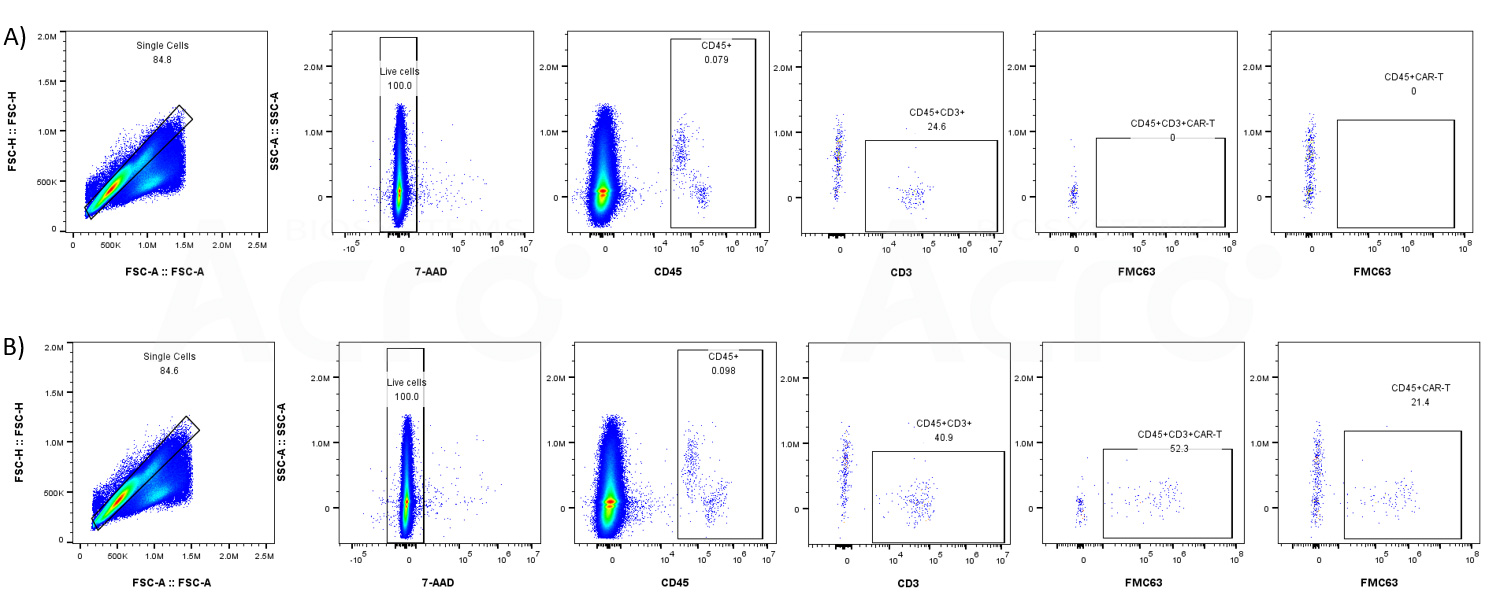
After Fc receptor blockade, whole blood only control (Figure A) and whole blood spiked with CAR-T cells (Figure B) were first stained with PE-Labeled Monoclonal Anti-FMC63 Antibody, Mouse IgG1 (Y45) (Site-specific conjugation) (Preservative free) (Cat. No. FM3-HPY53) , and then stained with 7-AAD. After 100-fold dilution, acquire data using a CytoFLEX S and then analyze the data with FlowJo. CAR-T cells were identified as PE-positive events within the live CD45+CD3+ (or CD45+) lymphocyte population. The proportion of CD45+CAR+ cells is around 20%, which is largely consistent with the theoretical spike-in value.
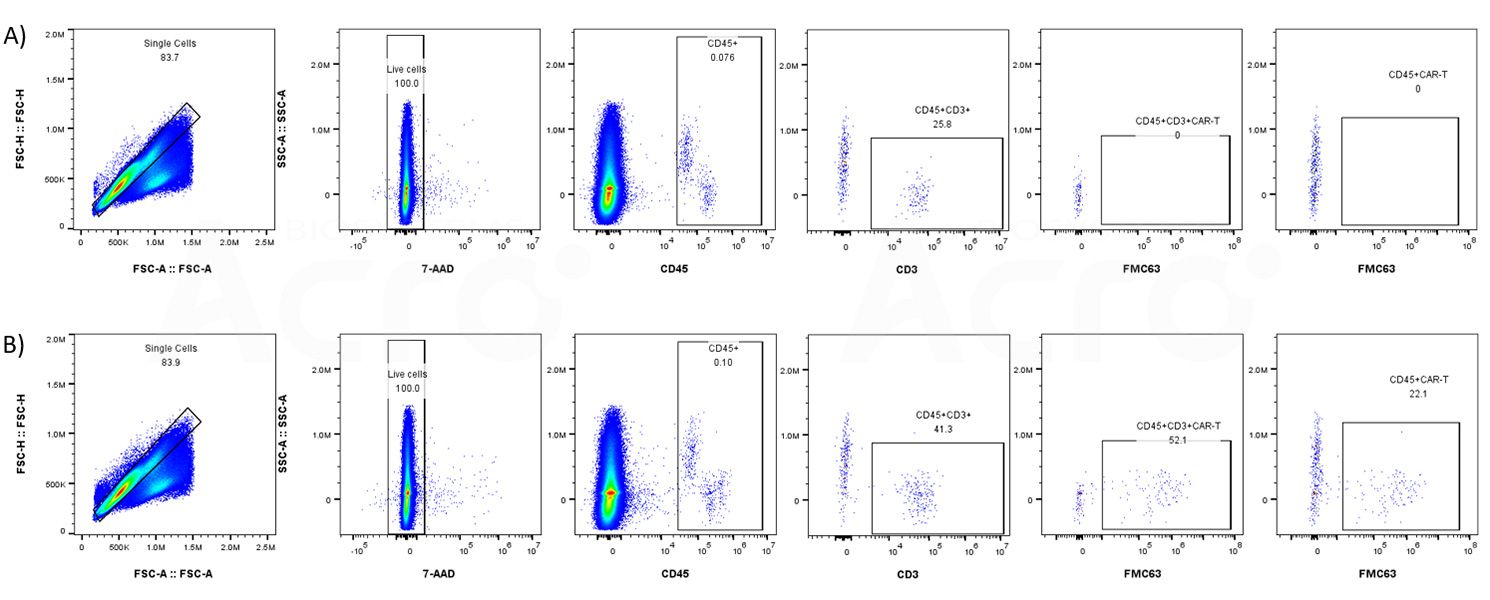
After Fc receptor blockade, whole blood only control (Figure A) and whole blood spiked with CAR-T cells (Figure B) were first stained with PE-Labeled Monoclonal Anti-FMC63 Antibody, Rabbit IgG (1G10) (Cat. NO. FM3-PFM721), and then stained with 7-AAD. After 100-fold dilution, acquire data using a CytoFLEX S and then analyze the data with FlowJo. CAR-T cells were identified as PE-positive events within the live CD45+CD3+ (or CD45+) lymphocyte population. The proportion of CD45+CAR+ cells is around 20%, which is largely consistent with the theoretical spike-in value.

2e5 of FMC63 scFv-based anti-CD19 CAR-293 cells were stained with 100 µL of the working solution of Monoclonal Anti-FMC63 scFv Antibody, Mouse IgG1 (Cat. No. FM3-Y45) and isotype control respectively, washed and then followed by PE anti-mouse IgG1 Antibody and analyzed with flow cytometry (QC tested).

Non-specific binding of Monoclonal Anti-FMC63 scFv Antibody (Cat. No. FM3-Y45) to non-transfected 293 cells was determined by flow cytometry. The data showed that Anti-FMC63 scFv Antibody didn’t bind to non-transfected 293 cells.

Non-specific binding of Monoclonal Anti-FMC63 scFv Antibody (Cat. No. FM3-Y45) to non-transfected human PBMCs was determined by flow cytometry. The data showed that Anti-FMC63 scFv Antibody didn’t bind to non-transfected human PBMCs.
Specifically recognize the antigen-binding site of FMC63 derived CARs with high affinity

Immobilized FMC63 scFv, His Tag at 2 μg/mL (100 μL/well) can bind Monoclonal Anti-FMC63 scFv Antibody, Mouse IgG1 (Clone Y45) with a linear range of 1-19 ng/mL. Anti-DNP antibody, mouse IgG1 (Cat. No. DNP-M1) was used as an isotype control (QC tested).

ELISA analysis shows that the binding of Human CD19, Fc Tag (Cat. No. CD9-H5251) to FMC63 scFv, His Tag was inhibited by increasing concentration of Monoclonal Anti-FMC63 scFv Antibody, Mouse IgG1 (Clone Y45). The concentration of Human CD19, Fc Tag used is 5 μg/mL (100 μL/well). The IC50 is 0.084 μg/mL (Routinely tested).

Monoclonal Anti-FMC63 scFv Antibody, Mouse IgG1 (Cat. No. FM3-Y45) captured on CM5 chip via anti-mouse antibodies surface can bind FMC63 scFv with an affinity constant of 1.08 nM as determined in a SPR assay.
Product List
 Order
OrderRelated products
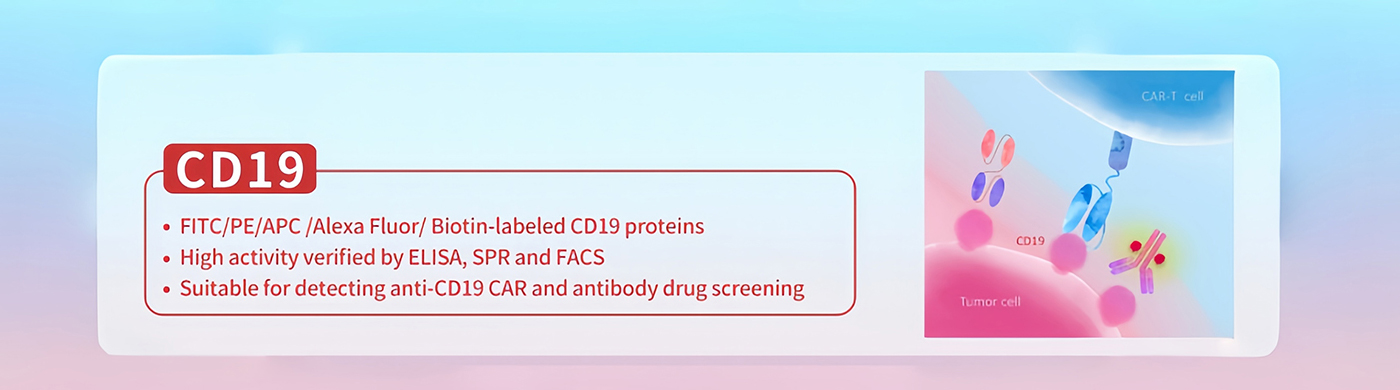
High Affinity CD19 Proteins
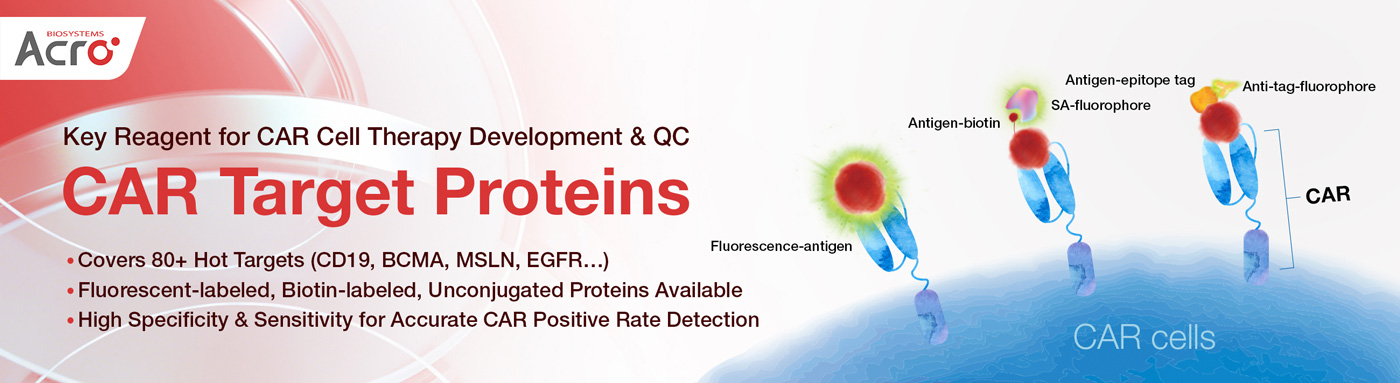
More CAR-T related products
FAQ
What is the relationship between the FMC63 clone and modern FDA-approved CAR-T therapies?
Why is an anti-idiotypic antibody, like Anti-FMC63, essential for monitoring CAR-T cells in patients?
How can I overcome the challenge of high background noise when detecting CAR expression in whole blood?
What are the strategies for evaluating the immunogenicity of a CD19 CAR‑T therapeutic candidate?
What are the unique advantages of using ACRO’s "Premium Grade" Anti-FMC63 antibodies in cell culture?
Can ACRO’s Anti-FMC63 tools be used to quantify the density of CAR expression on the cell surface?
Why is site-specific conjugation a superior standard for fluorescently labeled Anti-FMC63 antibodies?
How should I choose between Mouse and Rabbit host species for my Anti-FMC63 detection reagents?
- Background
- Product Features
- Product List
- Related products
- FAQ