



Anti-Idiotypic Antibody Development Service
Anti-idiotypic antibodies are antibodies that target the variable region of another antibody to produce specific binding. These antibodies are widely used in drug development: they can be used as an important reference standard for immunogenicity analysis or can be developed to specifically detect antibody drug levels for pharmacokinetic studies.
ACROBiosystems is committed to providing high quality key reagents and related services required in the development of targeted therapeutic drugs. We provide a series of anti-idiotypic antibodies with high affinity, high specificity, and high sensitivity. To meet the more unique needs of our customers, we also provide a one-stop service, starting from antigen preparation to monoclonal / polyclonal anti-idiotype antibody and pharmacokinetic / immunogenicity test kit development.
Advantages

Hardware Strength
Through the international AAALAC certification, we can standardize the management and use of animals to ensure the quality of antibodies.

Efficient Project Management
Dedicated one-on-one service with our project team with fast response and follow-up.

High Quality Materials
Key reagents for PK/ADA analysis are provided for a variety of different types of therapeutic drugs including monoclonal antibodies, bispecific antibodies, ADCs, and CAR-T).

Multifunctional Service
Services starting from antigen preparation to monoclonal / polyclonal anti-idiotype antibody development and PK/immunogenicity testing kit development.

Compliant with Regulatory Guidelines
We ensure that our PK/ADA test kits are delivered with sensitivity that meets regulatory requirements.
Services

We provide custom development of anti-idiotypic antibodies that are either antigen-neutralizing, non-neutralizing or drug target compound types. Depending on your application, these monoclonal anti-idiotypic antibodies can be used in the detection of free, bound, or total drug concentration in pharmacokinetic studies.

Block antigen-antibody binding
Detection of free antibody drugs
Detection of neutralizing antibodies

Not block antigen-antibody binding
Detection of total antibody drugs (free, semi-bound, bound)

Not block antigen- antibody binding
Specific detection of bound antibody drugs

For immunogenicity studies, we provide high-affinity and specific polyclonal anti-idiotypic antibody development services. These highly sensitive and diverse polyclonal anti-idiotypic antibodies can be used as a positive reference in immunogenicity studies, simulating the production of ADA inside the human body.
| Service | Immunogen | Platform | Period | Starting Material | Delivery | Typical Application | Price |
|---|---|---|---|---|---|---|---|
| Monoclonal Antibody |
mAb/F(ab)/F(ab)2VHH/SCFV BsAb/ADC/ protein/peptide/ payload,etc. |
Single B cell (Balb/c mouse or New Zealand white rabbit) |
15-21 weeks (Antibody screening: 9-13 weeks) |
1. ≥10 mg target antibody drug (client-provided, purity ≥90%, concentration ≥1 mg/mL) 2. 1 mg isotype control/human IgG (ACRO-provided, purity ≥90%) 3. 1 mg counter-screening antibody, if applicable (client-provided, purity ≥90%, concentration ≥1 mg/mL) 4. ACRO online products available for free use (excluding membrane proteins and other special proteins) |
1. Antibodies (quantity based on client request) 2. 2-10 unique sequences 3. Stage report (PPT) 4. Antibody CoA 5. Preliminary PK assay (optional) |
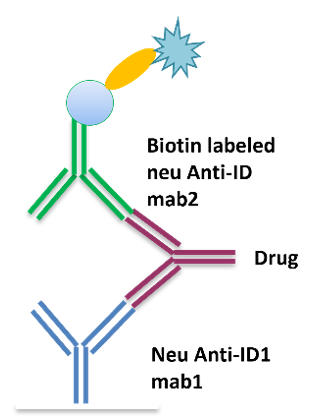
Essential detection reagent for pharmacokinetic studies and neutralizing antibody analysis |
One-on-one service of the project team Click here to contact us |
|
Hybridoma (Balb/c mouse) |
19-25 weeks | ||||||
| Rabbit Polyclonal Antibody | Rabbit polyclonal | 8-10 weeks |
1. Target antibody drug (client-provided, purity >90%); quantity dependent on client antibody requirement. (Example: ≥30 mg target antibody drug required to produce 10 mg polyclonal antibody.) 2. ≥30 mg isotype control/human IgG (ACRO-provided, purity >90%) |
1. Antibodies 2. Stage report (PPT) 3. Antibody CoA 4. Preliminary ADA assay (optional) QC standards: Non-specific cross-reactivity ≤2% Stability: 5 years Purity: SDS-PAGE ≥90% |
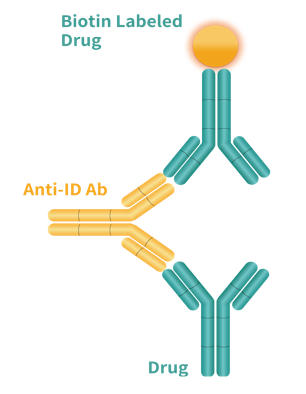
Positive control reagent for ADA detection |
Anti-idiotypic Antibody Product List
| Cat. No. | Target | Drug Name | Product Description | Order Now |
|---|---|---|---|---|
TNF-α |  Order Order | |||
TNF-α | Order | |||
TNF-α | Order | |||
BCMA | Order | |||
BCMA | Order | |||
BCMA | Order | |||
BCMA | Order | |||
VEGF-A | Order | |||
VEGF-A | Order | |||
VEGF-A | Order | |||
VEGF-A | Order | |||
EGF R | Order | |||
EGF R | Order | |||
EGF R | Order | |||
EGF R | Order | |||
EGF R | Order | |||
TROP-2 | Order | |||
TROP-2 | Order | |||
TROP-2 | Order | |||
TROP-2 | Order | |||
Her2 | Order | |||
Her2 | Order | |||
Her2 | Order | |||
Nectin-4 | Order | |||
Nectin-4 | Order | |||
Her2 | Order | |||
Her2 | Order | |||
Her2 | Order | |||
Her2 | Order | |||
Siglec-2 | Order | |||
Siglec-2 | Order | |||
Siglec-2 | Order | |||
CD79B | Order | |||
CD79B | Order | |||
CD79B | Order | |||
CD20 | Order | |||
CD20 | Order | |||
CD20 | Order | |||
TROP-2 | Order | |||
TROP-2 | Order | |||
TROP-2 | Order | |||
Her2 | Order | |||
Her2 | Order | |||
Her2 | Order |
Development Process
Case study
| Screened blocking clones against Arm 1 | |||||||||||
|---|---|---|---|---|---|---|---|---|---|---|---|
|
|
Clone1 | Clone2 | Clone3 | Clone4 | Clone5 | Clone6 | Clone7 | Clone8 | Clone9 | Clone10 | A0 |
| OD | 0.142 | 0.063 | 0.107 | 0.143 | 0.208 | 0.264 | 0.23 | 0.148 | 0.149 | 0.22 | 1.601 |
| blocking rate | 91.13% | 96.06% | 93.32% | 91.07% | 87.01% | 83.51% | 85.63% | 90.76% | 90.69% | 86.26% | / |
|
|
Clone11 | Clone12 | Clone13 | Clone14 | Clone15 | Clone16 | Clone17 | Clone18 | Clone19 | Clone20 | A0 |
| OD | 0.295 | 0.228 | 0.119 | 0.098 | 0.078 | 0.229 | 0.516 | 0.709 | 0.923 | 0.965 | 1.601 |
| blocking rate | 81.57% | 85.76% | 92.57% | 93.88% | 95.13% | 85.7% | 67.77% | 55.72% | 42.35% | 39.73% | / |
| Screened blocking clones against Arm 2 | |||||||||||
|---|---|---|---|---|---|---|---|---|---|---|---|
|
|
Clone1 | Clone2 | Clone3 | Clone4 | Clone5 | Clone6 | Clone7 | Clone8 | Clone9 | Clone10 | A0 |
| OD | 0.109 | 0.232 | 0.178 | 0.158 | 0.146 | 0.276 | 0.245 | 0.106 | 0.165 | 0.198 | 1.546 |
| blocking rate | 92.95% | 84.99% | 88.49% | 89.78% | 90.56% | 82.15% | 84.15% | 93.14% | 89.33% | 87.19% | / |
|
|
Clone11 | Clone12 | Clone13 | Clone14 | Clone15 | Clone16 | Clone17 |
|
|
|
A0 |
| OD | 0.48 | 0.495 | 0.387 | 0.658 | 0.064 | 0.651 | 1.062 |
|
|
|
1.546 |
| blocking rate | 68.95% | 67.98% | 74.97% | 57.44% | 95.86% | 57.89% | 31.31% |
|
|
|
/ |

Immobilized anti-arm1 antibody can bind Bispecific antibody drugs, and then add Biotin- anti-arm2 antibody. Detection was performed using HRP-conjugated streptavidin with sensitivity of 0.24 ng/mL (Intact Assay).

Immobilized Anti- drug Antibody, Mouse IgG1 can bind ADC antibody drugs, and then add Biotin- Mouse Anti-MMAE Antibody, Mouse IgG1 (MALS verified). Detection was performed using HRP-conjugated streptavidin with sensitivity of 0.69 ng/mL (Intact Assay).
| Testing method | Coated | Sample | Testing |
| Antigen capture ELISA | CD20 | Antibodies to be tested | Goat anti-human IgG |
| Anti-idiotypic capture ELISA | Anti-Ritux*mab Antibodies | Antibodies to be tested | Goat anti-human IgG |
| Bridging ELISA by anti-idiotypic antibodies | Anti-Ritux*mab Antibodies | Antibodies to be tested | Biotinylated Anti-Ritux*mab Antibodies |


| Testing method |
Linear range (µg/mL) |
Sensitivity (µg/mL) |
Advantage | Disadvantage |
| Antigen-capture ELISA | — | — | Simple method and good versatility | High background, no activity |
| Anti-idiotypic capture ELISA | 0.156-10 | 0.156 | Solve the difficulty in obtaining CD20, simple method | High background, only suitable for Rituxa biosimilar |
| Bridging ELISA by anti-idiotypic antibodies | 0.012-0.78 | 0.012 | Solve the difficulty in obtaining CD20, good sensitivity and low background | Only applicable to Rituxan biosimilar |

New Zealand white rabbits were immunized with full-length monoclonal antibodies. The antiserum was affinity purified for polyclonal antibodies specific to the drug. Cross reactivity to subtype control was less than 2%.

New Zealand white rabbits were immunized with polypeptide-KLH conjugates. Antiserum was purified by affinity chromatography until antibody titer was more than 1:712,000.

Anti-Adalimumab Antibodies bridging ELISA for Anti-Drug Antibody (ADA) assay development. Immobilized adalimumab at 1 µg/ml, add increasing concentrations of Anti-Adalimumab Antibodies (Cat. No. ADB-Y19, 10% human serum) and then add biotinylated adalimumab at 5 µg/ml. Detection was performed using HRP-conjugated streptavidin with a sensitivity of 0.6 ng/mL.

Anti-Rituximab Antibodies bridging ELISA for Anti-Drug Antibody (ADA) assay development. Immobilized rituximab at 1 µg/ml, added increasing concentrations of Anti-Adalimumab Antibodies (Cat. No. RIB-Y36, 10% human serum) and then added biotinylated rituximab at 2 µg/ml. Detection was performed using HRP-conjugated streptavidin with a sensitivity of 9.7 ng/mL.
Inquiry and order
Inquiry and order
-
ACROBiosystems scientist will respond within 24 hours of submission.
-
Call us at: +1 800-810-0816 or email at services@acrobiosystems.com for consultation.
- Background
- Advantages
- Services
- Anti-idiotypic Antibody Product List
- Development Process
- Case study
- Inquiry and order