Bridging ELISA Kits: Streamline Your Bispecific Antibody Activity Assessment
 Publication Date:2026-07-13
 Page Views:122
Introduction: The Critical Role of Binding Activity in Bispecific Antibodies
The core competitiveness of bispecific antibodies (bsAbs) lies in their ability to simultaneously engage two targets with a single molecule, enabling novel mechanisms of action and unique clinical benefits beyond those of monoclonal antibodies or combination therapies. This dual-target engagement is fundamental to their therapeutic efficacy, safety, and overall developability. As the pipeline of bsAb therapeutics continues to expand across oncology and autoimmune diseases, precise assessment of bridging activity has become more than a technical requirement—it is increasingly a critical component of candidate selection, process development, and quality control throughout the development lifecycle.
Navigating the Challenges: From Traditional Assays to Ideal Solutions
An effective evaluation of bsAb binding must consider not only binding to individual targets but, more critically, the dual-target bridging effect. This capability serves as an essential quality control metric throughout the drug development lifecycle: enabling early-stage screening to eliminate candidates, ensuring batch-to-batch consistency during manufacturing, and supporting regulatory submissions with standardized data. However, accurately assessing the target-binding activity of bsAbs presents significant challenges at each stage of development. Traditional assays typically evaluate binding to each target separately, which fails to capture the physiologically relevant process of simultaneous dual-target engagement.
Assessment of BsAb Target-Binding Activity: Challenges vs. Ideal Solutions
| Traditional Challenges | Features of Ideal Solutions |
|---|---|
|
❌ High risk of functional misjudgment Single-target assays cannot replicate true "bridging" activity, often leading to misinterpretation of candidates in early screening and inefficient resource use. |
✅ Direct assessment of authentic bridging activity Quantitatively evaluates a bsAb's simultaneous engagement of both targets, ensuring results accurately reflect biological function and reducing early-stage misjudgment. |
|
❌ Poor data consistency In-house methods vary in antigen source, coating conditions, etc., resulting in significant batch-to-batch variability and weak comparability for regulatory submission. |
✅ Standardized system with long-term comparability Highly standardized methods ensure stable and comparable data across time, batches, and operators, supporting process optimization and regulatory submissions. |
|
❌ Long method development cycles Multiple assay systems must be developed separately, consuming significant time and personnel, slowing overall project progress. |
✅ Ready-to-use solutions for high efficiency Integrated and simplified workflows support high-throughput applications, maintaining data quality while significantly improving efficiency. |
The Power of Bridging ELISA: A Purpose-Built Solution
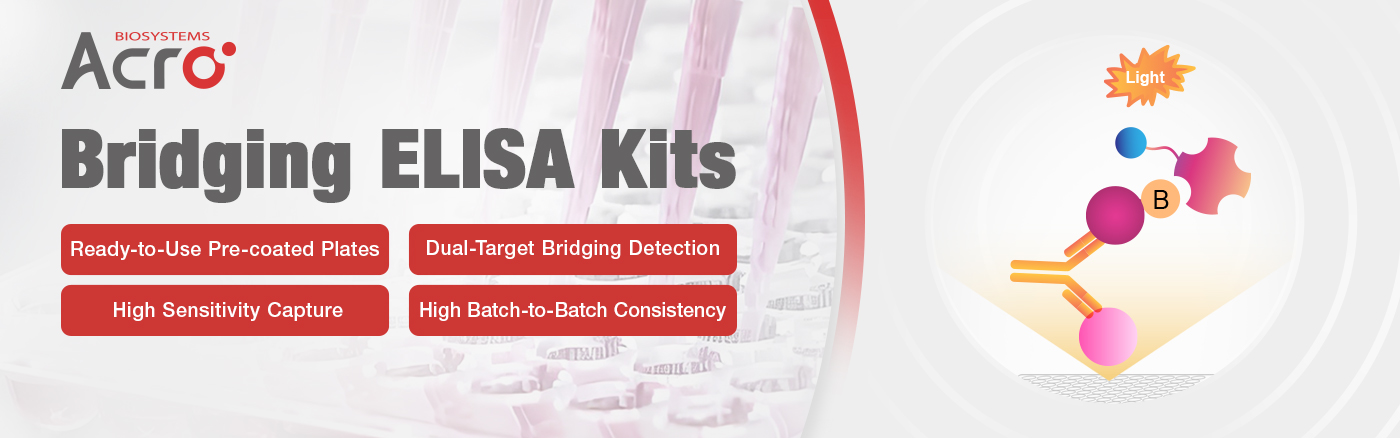
Selecting the scientific evaluation method and accurately assessing target-binding capability are crucial for streamlining bsAb development and accelerating the translation of effective therapeutics from the lab to the clinic. Leveraging advanced protein development platforms and a rigorous quality control system, ACROBiosystems has meticulously developed the Bridging ELISA Kits, providing standardized and efficient detection solutions for bsAb drug development.
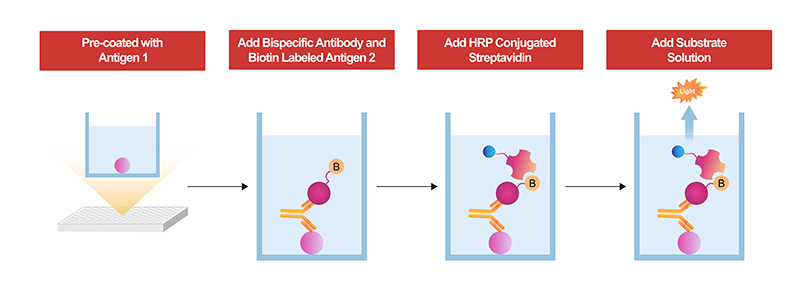
Schematic Workflow of the Bridging ELISA Kits
Product Advantages
- Simultaneous dual-target assessment for real biological activity
Designed based on the bridging ELISA principle, the kit evaluates bsAb binding to both targets in a single system. Results have been validated with marketed drugs, ensuring accuracy and reliability.
- Easy, efficient operation for high-throughput screening
Pre-coated plates eliminate manual coating and complex method development, simplifying workflows and enabling high-throughput applications to boost R&D efficiency.
- Rigorous quality control ensures batch consistency
Strict QC systems provide excellent batch-to-batch reproducibility, ensuring stable and comparable data for long-term research and quality control.
- Comprehensive validation supports regulatory submission
Includes full validation data and standard protocols, facilitating rapid in-house method development and providing strong support for regulatory filings.
- High performance with cost efficiency
Delivers excellent detection performance while reducing material and time costs, maximizing R&D value.
- Customizable to meet specific needs
Customized development services are available for specific target combinations, precisely meeting diverse and personalized requirements across various bsAb R&D scenarios.
Product List
| Cat. No. | Product Description |
|---|---|
| BIS-A001 | Bispecific Human BCMA & CD3E Bridging ELISA Kit |
| BIS-A002 | Bispecific Human CD19 & CD3 Bridging ELISA Kit |
| BIS-A003 | Bispecific Human CD20 & CD3E Bridging ELISA Kit |
| BIS-A004 | Bispecific Human Claudin-18.2 & CD3E Bridging ELISA Kit |
| BIS-A005 | Bispecific Human DLL3 & CD3E Bridging ELISA Kit |
| BIS-A006 | Bispecific Human EGFR & c-Met Bridging ELISA Kit |
| BIS-A007 | Bispecific Human KLK2 & CD3 Bridging ELISA Kit |
| BIS-A008 | Bispecific Human PD-1 & VEGF Bridging ELISA Kit |
| BIS-A009 | Bispecific Human PD-L1 & VEGF Bridging ELISA Kit |
FAQ:
Q1: Why is dual-target engagement becoming an increasingly important quality attribute for bispecific antibodies?
A: As bsAb formats continue to diversify, regulators and developers are placing greater emphasis on understanding how target engagement relates to mechanism of action. For many bsAbs, therapeutic activity depends not simply on binding two targets independently, but on simultaneously engaging both targets to enable their intended mechanism of action. Emerging research suggests that dual-target engagement data may provide additional insight into candidate differentiation, comparability assessment, and structure-function relationships. As a result, analytical strategies capable of evaluating simultaneous target engagement are becoming increasingly important throughout the bsAb development lifecycle.
Q2: How can researchers identify bsAb candidates with effective bridging activity during early discovery?
A: A common challenge during lead screening is that candidates may demonstrate binding to each target individually while exhibiting limited simultaneous engagement capability. This discrepancy can lead to overestimation of candidate performance and inefficient downstream development. To reduce this risk, researchers increasingly incorporate dual-target engagement assessments during candidate selection. Bridging ELISA-based assays directly evaluate simultaneous target engagement within a single analytical system, helping prioritize candidates with robust bridging activity before advancing into more resource-intensive functional and in vivo studies.
Q3: How is Bridging ELISA different from conventional single-target binding assays?
A: Conventional binding assays typically assess interactions with each target independently, providing valuable information about individual target recognition. However, they do not directly evaluate whether a bsAb can engage both targets simultaneously. Bridging ELISA addresses this gap by measuring dual-target engagement within a single assay, providing a direct assessment of bridging activity that complements conventional binding and functional assays. This additional information supports candidate characterization, process development, and comparability studies.
Q4: At which stages of bispecific antibody development can Bridging ELISA Kits be used?
A: Bridging ELISA Kits can be applied throughout the bsAb development lifecycle. During early discovery, they help identify candidates with robust dual-target engagement. During process development and manufacturing, they support batch-to-batch consistency and assay standardization. They can also support analytical characterization and comparability studies by providing standardized assessment of dual-target engagement across different development stages.
Q5: Can Bridging ELISA Kits be applied to novel bispecific target combinations?
A: The rapid expansion of bsAb pipelines has introduced numerous emerging target combinations beyond traditional CD3-based T-cell engagers, including immune checkpoint combinations, angiogenesis-immunotherapy combinations, and next-generation tumor-selective bsAbs. For novel programs, assay development can become a significant bottleneck due to the need for qualified recombinant proteins and optimized assay conditions. Customizable Bridging ELISA platforms enable the development of target-specific assays tailored to unique antigen pairs, helping researchers establish standardized dual-target engagement assays earlier in the development process.
 Popular ArticlesRelated RecommendationsPopular Events
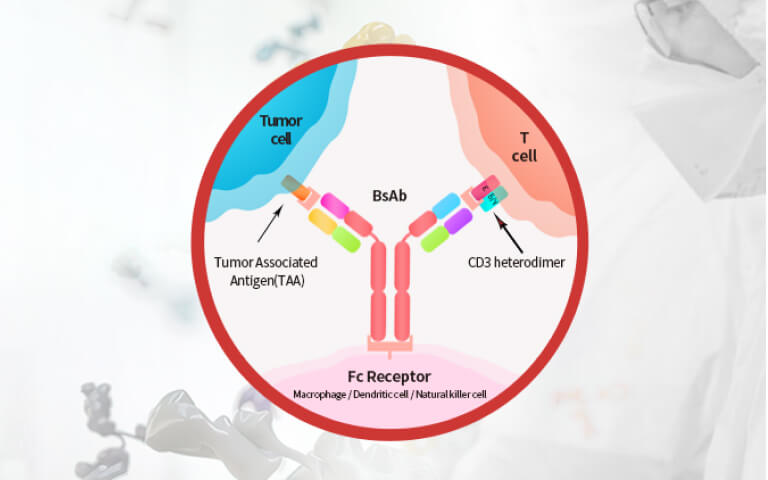 AI-Assisted Bispecific Antibody Development: From Target Pairing Prediction to Experimental Validation2026-07-31Page Views:51
 The Brain's Fountain of Youth: How Modern Neuroscience Is Decoding Healthy Brain Aging2026-07-31Page Views:20
 In Vivo CAR-T Therapy: Next-Generation CAR-T Cell Engineering and Gene Delivery Advances2026-07-29Page Views:45
 A Comprehensive Guide to Sterility Testing in Biopharmaceutical Manufacturing: From Compendial Methods to qPCR-Based Rapid Testing2026-07-27Page Views:66
 Biomarkers: Enabling Precision Assessment of Cardio-Kidney-Metabolic (CKM) Syndrome2026-07-24Page Views:96





 Related Products