



 Oct 19, 2026
 Page Views:107


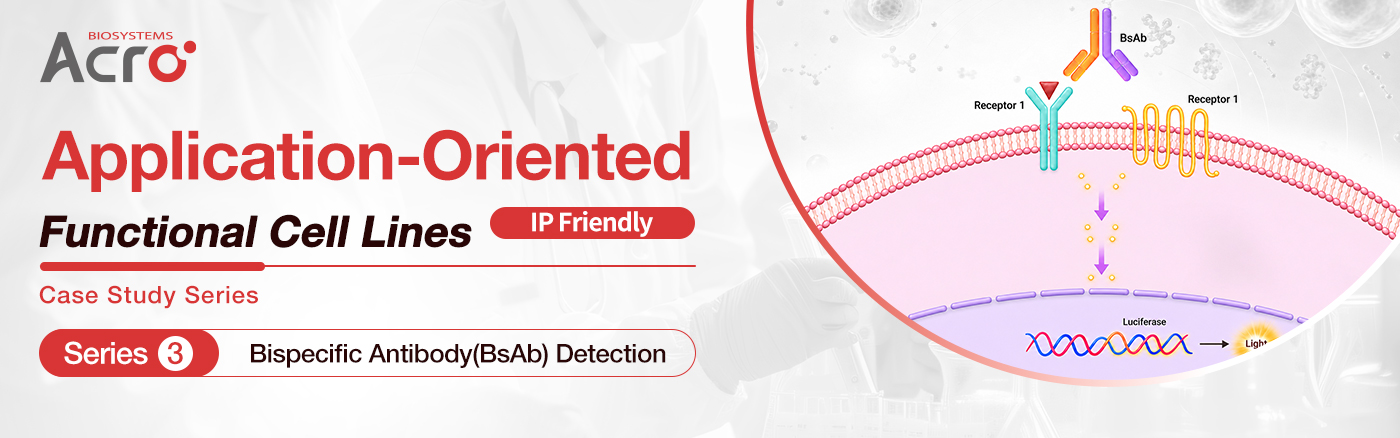
During drug development, functional cell lines are critical tools connecting drug design, in vitro functional validation, and clinical translational prediction, forming an essential foundation for drug efficacy assessment.
For drug development researchers, ideal cell lines feature qualified performance metrics and are engineered for practical R&D needs. They precisely recapitulate a drug's mechanism of action (MOA), fit multiple assay scenarios, and generate stable, reliable data as well as regulatory-supporting evidence to guide research decisions.
Focused on real-world drug discovery workflows, ACROBiosystems is committed to delivering "Application-Oriented Functional Cell Lines". Built around practical application demands, our stable, reliable, and reproducible cell line models help deliver trustworthy experimental results and accelerate drug development.
We will launch a series of application case studies to illustrate how functional cell lines benefit drug development. The content includes assay strategies, product selection, protocols and data analysis, and actionable reference solutions for researchers.
Previously in this series:
Series 1: Functional Cell Lines for ADCC/ADCP Functional Validation
Series 2: Functional Cell Lines for Anti-Drug Antibody (ADA) Validation
Series 3: we focus on the application of Functional Cell Lines in bispecific antibody (bsAb) bioactivity assays.
Two Targets ≠ Two Single Targets: Why BsAb Functional Assessment Goes Beyond Single-Target Assays
A bispecific antibody (bsAb) recognizes two distinct targets or epitopes within a single molecule, enabling complex mechanisms—such as dual-pathway blockade, synergistic effects, or cell bridging—that are difficult to achieve with monoclonal antibodies. Functional assessment of a BsAb therefore requires more than confirming the activity of each arm independently; it must also determine whether simultaneous engagement of both targets produces the integrated functional response expected from the mechanism of action (MOA).
In its guidance, Bispecific Antibody Development Programs, the FDA notes that BsAb development should assess whether simultaneous binding to both targets is required and whether dual-target engagement may generate synergistic effects. In other words, demonstrating the activity of each arm independently does not necessarily establish the overall functional activity of the bsAb.
Dual-Target Reporter Cell Lines: From “Two Arms” to “Dual Function”
For complex BsAb MOAs, dual-target reporter cell lines can present both targets in the same cellular background and assay system, converting the downstream biological effects of their combined engagement into a quantifiable signal.
ACROBiosystems has developed Dual-Target Reporter Cell Lines to support bsAb candidate screening, functional characterization, and MOA studies.
Case Study 1: Functional Assessment of PD-1 × LAG-3 BsAb Using a Dual-Target Reporter Cell Line
PD-1 and LAG-3 can jointly mediate T-cell inhibition. Measuring the activity of the PD-1 and LAG-3 arms separately in single-target cell lines only indicates whether each binding arm is functional; it does not show whether concurrent blockade of both inhibitory axes restores TCR signaling when both targets are co-expressed. A reporter cell line co-expressing PD-1 and LAG-3, paired with target cells presenting PD-L1 and MHC II, can therefore be used to measure the functional outcome of dual-pathway blockade.
Recommended Functional Cell Line:
Human PD-1/LAG-3 (Luc) Jurkat Reporter cell(Cat. No. SCJUR-STF063 )
Method:
The Human PD-1/LAG-3 (Luc) Jurkat Reporter Cell co-expresses PD-1 and LAG-3 together with an NFAT-Luc reporter system. The reporter cells are co-cultured with PD-L1/MHC II double-positive target cells and treated with serial dilutions of PD-1 and LAG-3 antibodies. If both functional arms are active in this model, the two inhibitory signals are relieved concurrently, resulting in increased NFAT-driven luciferase activity.
Results:
In this assay system, combined treatment with PD-1 and LAG-3 antibodies produced a clear dose-dependent increase in NFAT-driven luciferase activity, with an EC50 of approximately 0.58 μg/mL. These results demonstrate the assay’s ability to measure functional responses associated with combined PD-1 and LAG-3 blockade.
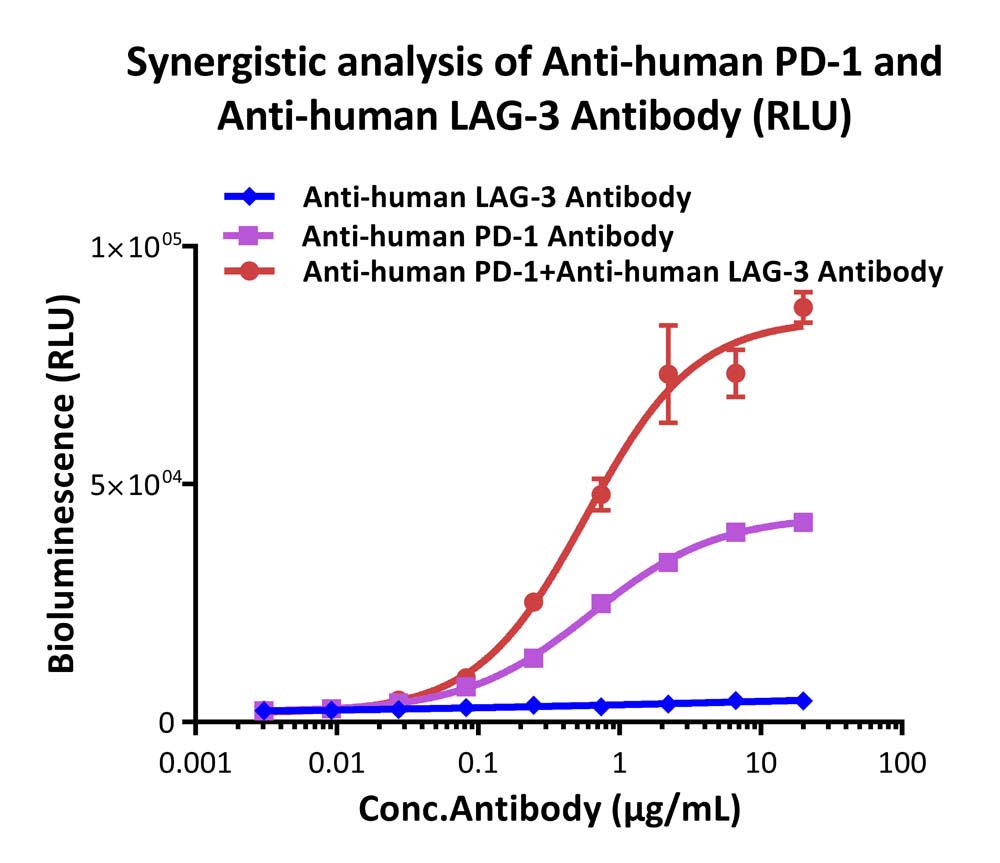
Analysis of the synergistic effect for anti-human PD-1 and anti-human LAG-3 antibody (RLU).
This reporter cell was co-incubated with serial dilutions of anti-human PD-1 plus anti-human LAG-3 antibody in the presence of target cells expressing human PD-L1 and MHC II. The EC50 was approximately 0.58 μg/mL.
Case Study 2: Revealing BsAb-Specific Potency with an EGFR & LGR5 Dual-Target Reporter Cell Line
For an EGFR × LGR5 bsAb, observing an inhibition curve only in an EGFR single-target model does not establish whether the LGR5 arm makes a functional contribution in a double-positive cellular background. A more comprehensive design evaluates EGFR single-target cells and EGFR/LGR5 dual-target cells within the same assay system, using an EGFR monoclonal antibody and the EGFR × LGR5 bsAb as mechanistic controls.
Recommended Functional Cell Line:
Human EGFR & LGR5 (SRE-Luc) HEK293 Reporter Cell (Cat. No. CHEK-ATF288)
Method:
Under identical EGF stimulation conditions (final concentration: 0.005 μg/mL), the EGFR reporter cell line and the EGFR & LGR5 reporter cell line are separately incubated with serial dilutions of an EGFR-neutralizing monoclonal antibody or an EGFR × LGR5 bsAb. EC50 values in the two cellular backgrounds are then compared using the SRE-driven luciferase signal.
Results:
| Assessment Item | EGFR monoclonal antibody | EGFR × LGR5 bsAb |
|---|---|---|
| Single-Target Cell Line | EC50 = 0.01652 μg/mL | EC50 = 0.0637 μg/mL |
| Dual-Target Cell Line | EC50 = 0.01992 μg/mL | EC50 = 0.01716 μg/mL |
| Potency Shift | ≈ 0.83× | ≈ 3.71× |
| Interpretation | Co-expression of LGR5 did not enhance the inhibitory activity of the EGFR monoclonal antibody. | By contrast, the EGFR × LGR5 bsAb showed a marked increase in potency in the dual-target cellular background. |
Together, these results demonstrate that the dual-target reporter cell line can detect enhanced bsAb-specific potency in the presence of LGR5, providing insights into the functional contribution of the second target.
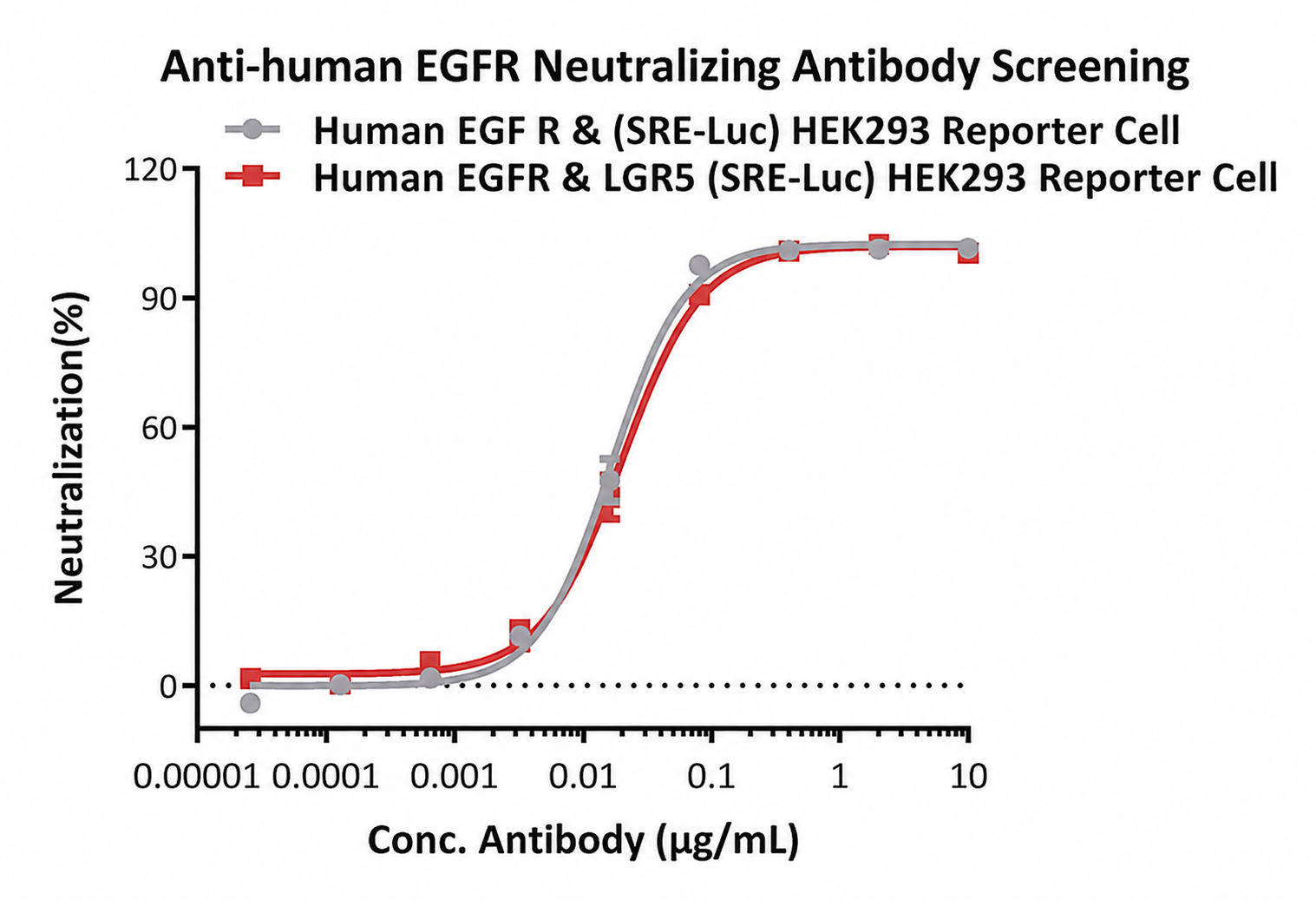
Inhibition of human EGF protein-induced reporter activity by anti-human EGFR neutralizing antibody.
The Human EGFR & LGR5 (SRE-Luc) HEK293 Reporter Cell (Cat. No. CHEK-ATF288) and the parental Human EGFR (SRE-Luc) HEK293 Reporter Cell (Cat. No. CHEK-ATF278) were incubated with serial dilutions of anti-human EGFR neutralizing antibody in the presence of human EGF protein (Cat. No. EGF-H52H3) at a final concentration of 0.005 μg/mL. The EC50 values determined using the Human EGFR (SRE-Luc) HEK293 Reporter Cell and the Human EGFR & LGR5 (SRE-Luc) HEK293 Reporter Cell were approximately 0.01652 μg/mL and 0.01992 μg/mL, respectively. The fold change, calculated as EC50 for the Human EGFR (SRE-Luc) HEK293 Reporter Cell divided by EC50 for the Human EGFR & LGR5 (SRE-Luc) HEK293 Reporter Cell, was approximately 0.83.
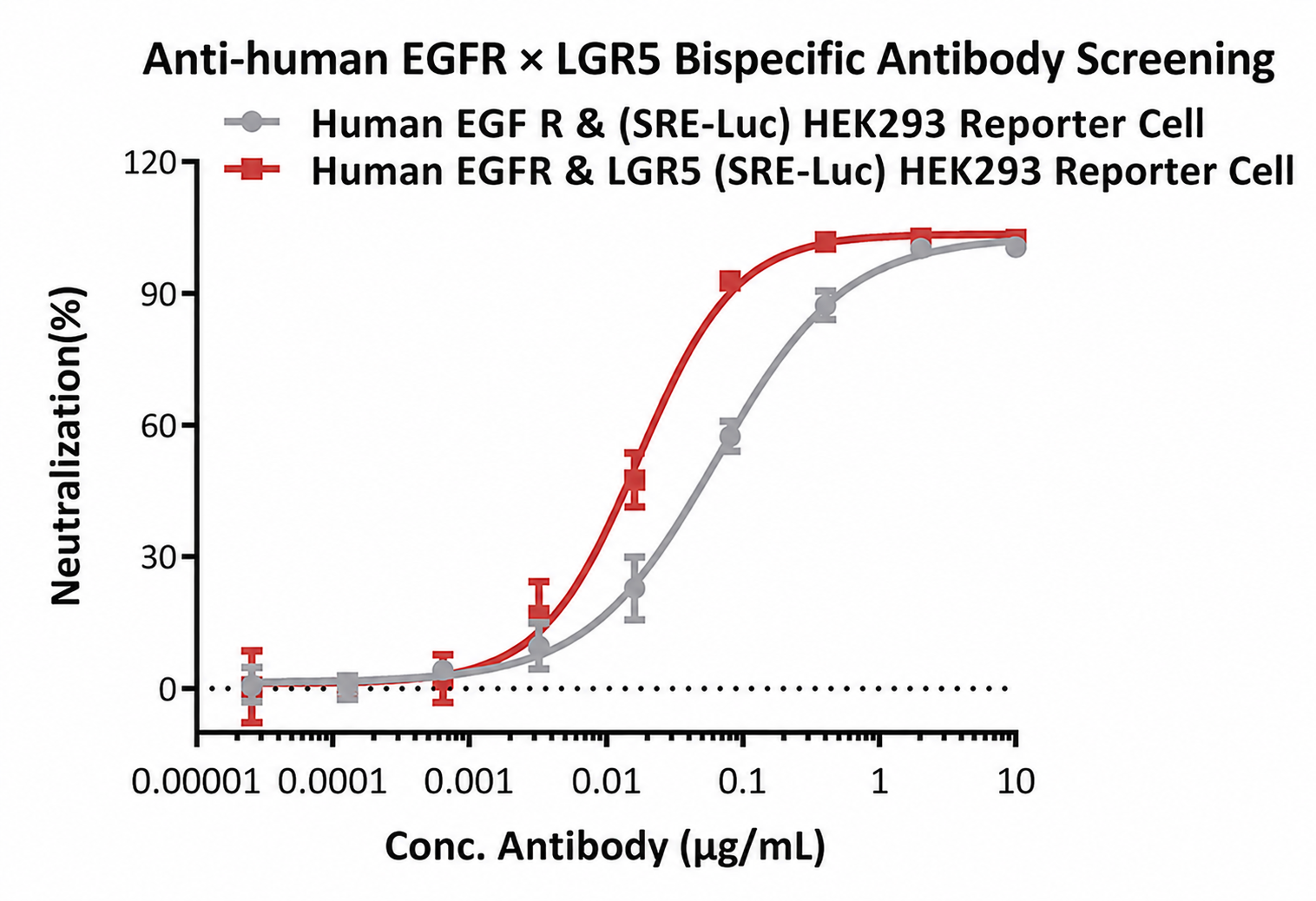
Inhibition of human EGF protein-induced reporter activity by anti-human EGFR × LGR5 bsAb.
The Human EGFR & LGR5 (SRE-Luc) HEK293 Reporter Cell (Cat. No. CHEK-ATF288) and the parental Human EGFR (SRE-Luc) HEK293 Reporter Cell (Cat. No. CHEK-ATF278) were incubated with serial dilutions of an anti-human EGFR × LGR5 bsAb in the presence of human EGF protein (Cat. No. EGF-H52H3) at a final concentration of 0.005 μg/mL. The EC50 values determined using the Human EGFR (SRE-Luc) HEK293 Reporter Cell and the Human EGFR & LGR5 (SRE-Luc) HEK293 Reporter Cell were approximately 0.0637 μg/mL and 0.01716 μg/mL, respectively. The fold change, calculated as EC50 for the Human EGFR (SRE-Luc) HEK293 Reporter Cell divided by EC50 for the Human EGFR & LGR5 (SRE-Luc) HEK293 Reporter Cell, was approximately 3.71, demonstrating that LGR5 overexpression enhanced the inhibitory activity of the anti-human EGFR × LGR5 bsAb.
Case Study Summary
These two case studies highlight the value of dual-target reporter cell lines in BsAb functional assessment.
The PD-1 × LAG-3 model measures functional responses following combined blockade of two inhibitory pathways, while the EGFR × LGR5 model reveals enhanced bsAb-specific potency in a dual-target cellular background.
Together, they demonstrate how dual-target reporter cell lines can provide functional insights beyond conventional single-target assays.
Moving forward, we will continue to expand our Application-Oriented Functional Cell Lines Case Study Series, covering more drug development scenarios, standardized assay protocols, practical product selection guidance, and real experimental data.
We welcome your feedback on future research topics and technical challenges. Stay tuned for more application-driven case studies tailored to your drug development needs.