Oct 30, 2026
 Page Views:22


iPSCs are the promise. The medium is the bottleneck.
Induced pluripotent stem cells(iPSCs) can expand indefinitely and differentiate on demand into HSPCs, NK cells, T cells, platelets, and other hematopoietic lineages. That makes them a leading candidate source for "off-the-shelf" cell therapies for hematologic malignancies, solid tumors, and bleeding disorders. Unlike donor-derived primary cells, an iPSC master cell bank is uniform, scalable, and free of donor-to-donor variability. Reviews now chart this as a working platform, not a concept: iPSC-derived NK cells are being positioned as scalable, off-the-shelf cancer immunotherapies because a single iPSC master bank can supply clonally uniform, genetically engineerable NK cells, and more than a decade of work on iPSC-to-hematopoiesis protocols has been mapped toward clinical-scale HSPC generation.
But between a qualified iPSC bank and a clinic-ready cell drug sits a humble consumable: the differentiation medium. It decides what every batch of cells looks like, how well they survive, and whether the data can be reproduced. For iPSC this is especially unforgiving. Compared with mesenchymal stromal cells (MSCs), PSCs are highly sensitive to culture conditions. Small fluctuations in medium composition can affect differentiation efficiency and cell population composition, while residual undifferentiated cells may pose tumorigenicity risks that must be addressed through appropriate process controls and quality assessments.
That is why a reliable iPSC-to-hematopoietic-lineage differentiation medium is not "a slightly more expensive reagent". It is a critical raw material that determines whether the whole pipeline works.
Four gaps in today's HSPC differentiation media
Differentiating iPSCs into hematopoietic lineages is a long, multi-stage process. Four practical problems are common among commercial HSPC differentiation media:
- Yield varies widely. Under the same starting conditions, the CD34⁺CD45⁺ HSPC output of different products can differ by more than 2-fold. Differentiation outcomes become a matter of luck, and scale-up makes the variance worse. This is not anecdotal: published head-to-head comparisons of differentiation protocols report materially different HSPC outputs from comparable starting cells, and yields also vary widely between iPSC lines.
- Batch-to-batch consistency falls short. In non-chemically-defined production modes, variations in medium composition may lead to inconsistent differentiation outcomes.. The same cells cultured with a new lot number may behave entirely differently, and the stability studies required for clinical filing become hard to run. Standards bodies treat this as a formal risk: ISO 20399 states that variation in the lot-to-lot composition of ancillary materials can hamper the ability to produce consistent cell and gene therapy products with specified quality attributes.
- Opaque, animal-origin formulations. Media containing bovine serum or hydrolysates can introduce risks of viral or prion contamination and complicate raw-material quality control and regulatory documentation. Regulators treat this as structural risk: USP General Chapter 1043 emphasizes risk-based qualification of ancillary materials, including the evaluation of animal-derived components and potential adventitious agents.. FDA's CMC guidance for human gene therapy INDs likewise expects sponsors to qualify raw materials and mitigate adventitious-agent risk.
- Fragmented systems. Many products cover only the iPSC-to-HSPC stage. Differentiation into NK cells, T cells, or platelets then requires separate systems and repeated medium switches. And if research-use-only (RUO) and GMP grades use different formulations, moving to the clinic adds formulation changes and re-validation on top of everything else. USP 1043 emphasizes risk-based qualification of ancillary materials, while GMP-grade materials can provide additional quality assurance and traceability for clinical manufacturing.
Each gap alone is manageable. Together, they turn a defined biological process into an experience-dependent craft.
One medium across the whole hematopoietic workflow
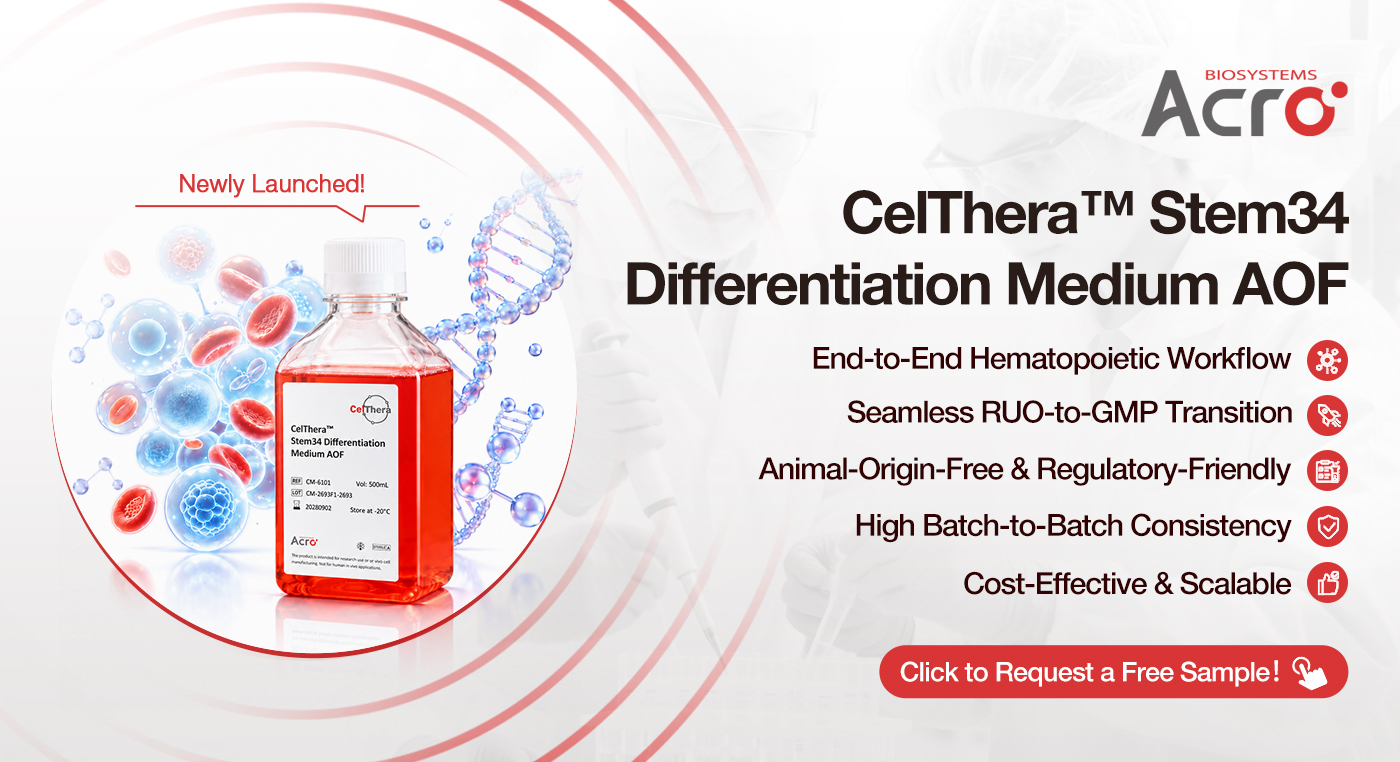
CelThera™ Stem34 Differentiation Medium AOF (Cat. No. CM-6101) was designed against exactly these four gaps. It is chemically defined and animal-origin-free (AOF). It supports the efficient differentiation of PSCs into HSPCs and then continues across the full workflow into NK cells and megakaryocyte/platelet lineages, with potential applications in T cells and other hematopoietic lineages — without switching the basal medium. Stage-specific supplements — SCF, TPO, FLT3L, and IL-7, plus a DLL4/VCAM-1 coating system — carry the cells through each step.
The RUO and GMP grades share the same formulation. For teams that are doing research today and filing an IND tomorrow, that means early data and process routes can be more readily transferred to GMP manufacturing, subject to appropriate process qualification and comparability assessments. Less process change, potentially reduced re-validation efforts, and experiments that can accumulate into regulatory assets instead of being repeated.
Head-to-head data: what the numbers show
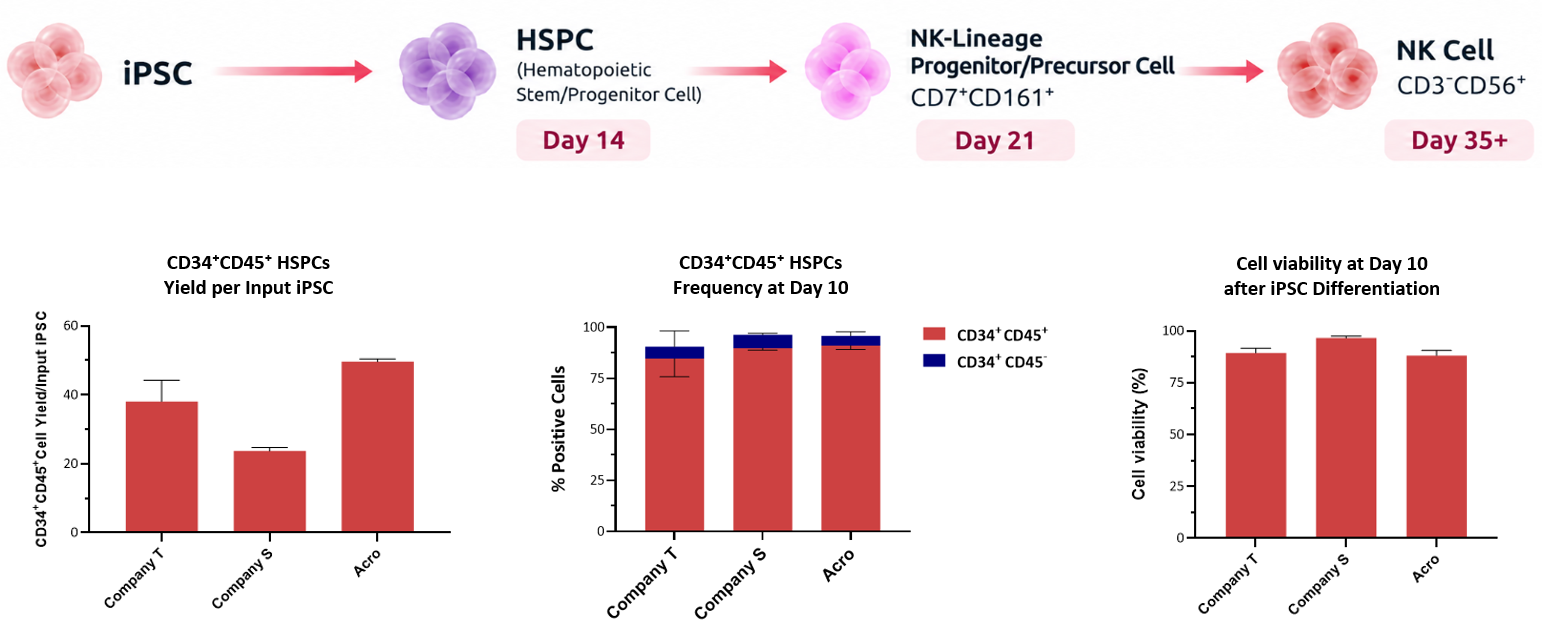
From iPSC to HSPC: Using CelThera™ Stem34 Differentiation Medium AOF (CM-6101), iPSCs were induced toward hematopoietic stem and progenitor cells (HSPCs) in a 3D embryoid body (EB) culture system. At the evaluated HSPC differentiation stage, compared with two commercial media on the market, the medium yielded a higher output of CD34⁺CD45⁺ HSPCs, while maintaining a high CD34⁺CD45⁺ positive fraction and high cell viability.
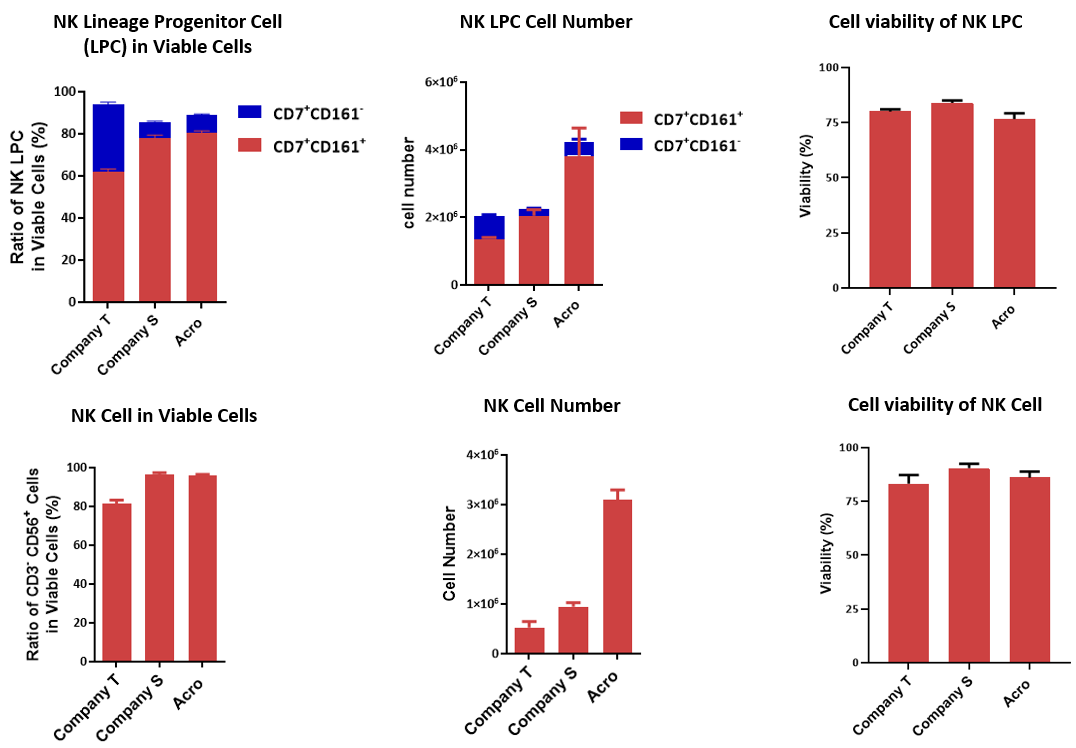
From HSPC to NK: Using CelThera™ Stem34 Differentiation Medium AOF (CM-6101), the medium efficiently supported the differentiation of iPSC-derived HSPCs toward the natural killer (NK) cell lineage, yielding a high proportion of CD7⁺CD161⁺ NK lineage progenitor cells (LPCs). As differentiation proceeded further, a high proportion of CD3⁻CD56⁺ NK cells was obtained, with an output notably higher than that of the two commercial media on the market, while maintaining high cell viability.
Beyond the medium: GMP backing and a complete CMC toolkit
A differentiation medium never works alone. Stem34 sits on the CelThera™ platform, which is built to clinical-grade standards: class B+A production environment, ISO 9001/ISO 13485 quality management, and release testing on every batch for endotoxin, sterility, and cell proliferation performance. The CelThera™ GMP-grade cell culture medium series has completed FDA Drug Master File (DMF) filings across the entire product line, so customers can reference the relevant DMFs in global regulatory submissions and streamline IND/NDA preparation.
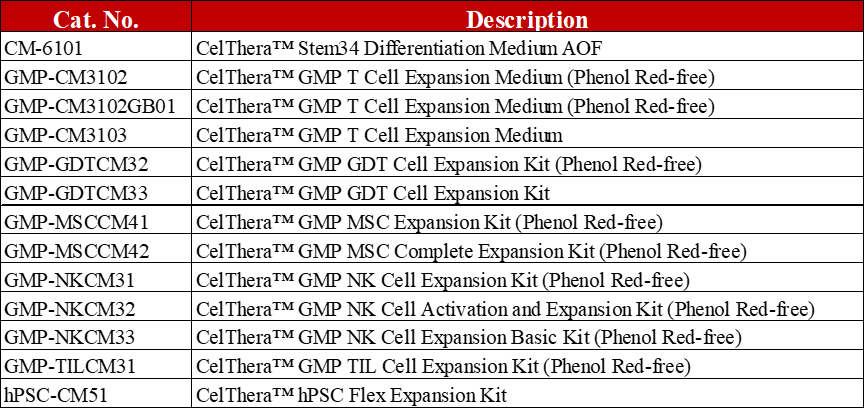
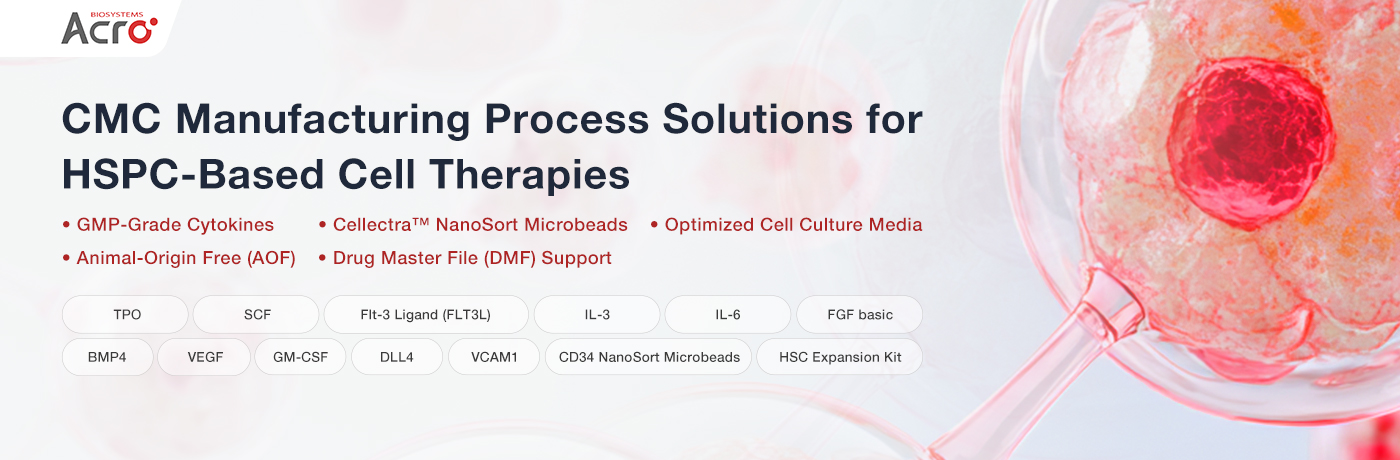
Around the medium, ACROBiosystems supplies the rest of the workflow: activation/separation beads, GMP-grade cytokines (BMP4, VEGF165, SCF, TPO, FLT3L, DLL4, IL-7, and more), Laminin 521/511 matrix proteins, and mycoplasma and endotoxin detection kits. One medium grows into a full CMC solution, sourced from one supplier.
The takeaway
Replace experience-dependence with a chemically defined, animal-origin-free formulation. Replace a patchwork of stage-specific systems with one continuous medium that carries RUO data into GMP manufacturing. For teams determined to move cells from the bench to the clinic, the certainty built into upstream raw materials is the part of the process that is easiest to overlook — and most worth taking seriously.