






 COA



- Product Details
- Performance Data
- Reviews & Citations
- Resources
1/1

ENPP1
Biotinylated Human ENPP1 Protein, His,Avitag (EN1-H82Q3) is expressed from human 293 cells (HEK293). It contains AA Lys 98 - Asp 925 (Accession # P22413).
Predicted N-terminus: His
This protein carries a polyhistidine tag at the N-terminus, followed by an Avi tag (Avitag™).
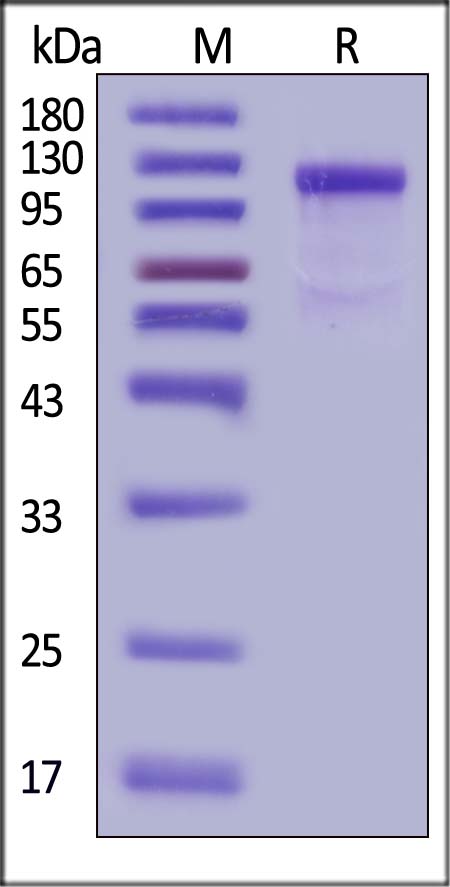
The protein has a calculated MW of 98.7 kDa. The protein migrates as 95-130 kDa when calibrated against Star Ribbon Pre-stained Protein Marker under reducing (R) condition (SDS-PAGE) due to glycosylation.
Biotinylation of this product is performed using Avitag™ technology. Briefly, the single lysine residue in the Avitag is enzymatically labeled with biotin.
Passed as determined by the SABA assay / HABA assay / binding ELISA.
>90% as determined by SDS-PAGE.
Lyophilized from 0.22 μm filtered solution in 50 mM Tris, 150 mM NaCl, pH7.5 with trehalose as protectant.
Contact us for customized product form or formulation.
Please see Certificate of Analysis for specific instructions.
For best performance, we strongly recommend you to follow the reconstitution protocol provided in the CoA.
This product is shipped at ambient temperature.
For long term storage, the product should be stored at lyophilized state at -20°C or lower.
Please avoid repeated freeze-thaw cycles.