


 Nov 26, 2026
 Page Views:38


Bioprocess Essentials: Why Purification Governs Recombinant Protein Quality
Following heterologous expression, crude biological harvests contain complex mixtures of host cell proteins (HCPs), genomic DNA and RNA, media additives, cellular debris, and heterogeneous target variants. Recombinant protein purification is the downstream bioprocess of systematically isolating the target polypeptide from these process- and product-related impurities by exploiting differences in molecular charge, surface hydrophobicity, molecular size, and biological affinity.[1]
The Three Operational Stages of Downstream Processing:
• Harvest Clarification & Sample Pretreatment: Depending on the expression strategy, intracellular targets require mechanical homogenization or chemical cell lysis followed by differential centrifugation, whereas secreted targets are recovered directly from cell-free culture supernatants. Appropriate filtration can remove insoluble material to protect downstream chromatography beds from fouling.
• Primary Capture Chromatography: Employs high-selectivity interactions—predominantly affinity chromatography—to achieve rapid volume concentration and extract the target protein from the crude feedstream.
• Intermediate & Polishing Chromatography: Resolves closely related product variants, including misfolded species, charge isoforms (deamidation, oxidation), structural truncations, and high-molecular-weight aggregates to achieve defined biochemical homogeneity.
Core Chromatographic Purification Methodologies
Selecting appropriate chromatography cascades depends on the target molecule's physical properties, presence of engineered affinity tags, and intended experimental applications:
Affinity Chromatography: Exploiting Biological Specificity
Affinity chromatography (AC) provides high selectivity and rapid volume reduction by exploiting reversible interactions between the target protein and an immobilized ligand:
• Polyhistidine Tags (His-Tag): Immobilized Metal Affinity Chromatography (IMAC) coordinates His-tags with transition metal ions (Ni2+ or Co2+) under physiological or mild denaturing conditions.
• Fc-Fusion Proteins: Employs Protein A or Protein G ligands to capture immunoglobulin Fc domains, with recovery and host protein clearance depending on process conditions.
• Glutathione S-Transferase (GST) Tags: Leverages glutathione-functionalized matrices to capture GST-fusion proteins, often utilized to enhance the expression solubility of bacterial constructs.
• Strep-Tag Systems: Utilizes engineered streptavidin variants (such as Strep-Tactin) to bind minimal peptide tags under mild, non-denaturing elution conditions.
While affinity tags simplify initial capture, their spatial placement can induce steric hindrance or alter native receptor binding. For structural biology and clinical biomanufacturing, engineered endoprotease cleavage sites (such as TEV protease) permit post-purification tag removal.
Ion Exchange Chromatography: Exploiting Net Surface Charge
Ion Exchange Chromatography (IEX) separates proteins based on reversible electrostatic interactions between accessible surface charges and charged stationary phase ligands at specific buffer pH values:
• Anion Exchange (AEX): Positively charged resins (e.g., Q or DEAE matrices) bind proteins carrying a net negative charge (pH > isoelectric point, pI). AEX is widely used in flow-through or bind-and-elute modes to clear negatively charged host cell DNA and endotoxins.
• Cation Exchange (CEX): Negatively charged resins (e.g., SP or CM matrices) bind proteins carrying a net positive charge (pH < pI). CEX provides high resolution for separating product-related charge variants, such as deamidated or C-terminally truncated species.
Hydrophobic Interaction Chromatography: Exploiting Surface Hydrophobicity
Hydrophobic Interaction Chromatography (HIC) separates proteins based on differences in surface-exposed hydrophobic patches under non-denaturing conditions. Samples are bound to moderately hydrophobic matrices (e.g., phenyl, butyl, or octyl ligands) in high-salt lyotropic mobile phases (such as ammonium sulfate) and eluted along a descending salt gradient. HIC can serve as an intermediate or polishing step when the target and impurities differ in hydrophobicity.
Size Exclusion Chromatography: Exploiting Hydrodynamic Volume
Size Exclusion Chromatography (SEC), or gel filtration, separates proteins according to their hydrodynamic volume as molecules diffuse through porous stationary phase beads:
• Preparative SEC: Utilized as a final polishing operation to separate monomeric target proteins from high-molecular-weight oligomers and aggregates, while simultaneously performing formulation buffer exchange.[2]
• Analytical SEC: Serves as a standard quality control assay to monitor solution homogeneity, quantitate aggregate content, and track stability over time.[2]
Post-Purification Quality Evaluation & Analytical Characterization
Following downstream chromatography, purified recombinant proteins must undergo multi-attribute analytical testing to verify structural integrity, identity, and solution homogeneity.[2]
Table 1: Primary Biophysical Quality Evaluation Matrix for Purified Recombinant Proteins
|
Validation Dimension |
Analytical Methodology |
Key Biological & Physicochemical Readout |
Quality & Regulatory Significance |
|---|---|---|---|
|
Label-Free Binding Kinetics |
Surface Plasmon Resonance (SPR) / BLI |
Association rate (ka), dissociation rate (kd), affinity (KD) |
Confirms functional epitope accessibility and kinetic affinity parameters |
|
Cellular Potency Assays |
Proliferation, Reporter Gene, Cytokine Release |
Half-maximal effective concentration (EC50 / ED50) |
Validates physiological signal transduction and intracellular potency |
|
Thermal & Colloidal Stability |
nanoDSF, Static / Dynamic Light Scattering |
Melting temp (Tm), aggregation onset (Tagg), radius (Rh) |
Identifies optimal buffer matrices to prevent self-association |
|
Accelerated Shelf-Life Modeling |
Arrhenius kinetic thermal stress testing |
Degradation rate constants across elevated temperatures |
Supports stability assessment alongside real-time data |
Purity vs. Functional Conformation: A Critical Distinction
A fundamental principle of protein quality control is that high chromatographic purity does not equal authentic tertiary folding or biological activity. A single sharp band on an SDS-PAGE gel may indicate electrophoretic purity, but cannot detect:[2]
a. Inactive, misfolded tertiary conformers lacking functional active-site architecture.
b. Soluble non-covalent aggregates that form avidity artifacts in binding assays.[3]
c. Incorrect disulfide bond pairing or scrambled multimeric assemblies.
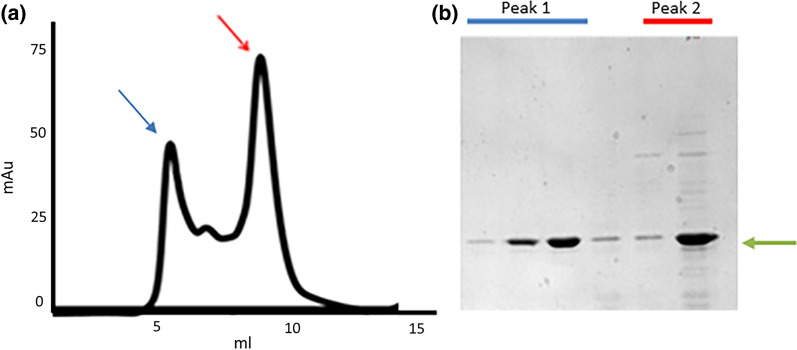
Figure 1. Separation of soluble nanobody aggregates by size-exclusion chromatography. (a) The first peak corresponds to the void volume, while the last peak represents the monomeric nanobody. (b) SDS-PAGE analysis of elution fractions showing different purity levels, with the nanobody remaining the major protein across fractions.[3]
Source: https://doi.org/10.1186/s12934-022-01778-5
Comprehensive quality release requires coupling electrophoretic purity with biophysical mass verification and functional characterization.[2]
Troubleshooting Common Purification Bottlenecks:
• Low Recovery Yield: Frequently stems from proteolytic degradation during cell lysis, non-specific binding to column matrices, incomplete elution, or low upstream expression titers.
• Soluble Target Aggregation: Triggered by high protein concentrations, unfavorable buffer pH near the protein's pI, low ionic strength, repeated freeze-thaw cycles, or exposed hydrophobic domains.[2]
• High Purity with Compromised Bioactivity: Occurs when harsh elution buffers (e.g., unsuitable low-pH elution) induce denaturation, when steric tag placement blocks active binding sites, or when prokaryotic hosts fail to execute required eukaryotic post-translational modifications.[3]
• Elevated Residual Endotoxin: Common in bacterial (E. coli) expression systems and may require dedicated removal steps to prevent non-specific immune cell activation.[1]
Conclusion: Transitioning from Downstream Purification to Multi-Dimensional Validation
Recombinant protein purification requires tailored downstream cascades designed around the target protein's structural topology, engineered tags, isoelectric point, and intended experimental applications. Primary affinity capture rapidly isolates target molecules, while orthogonal ion exchange, hydrophobic interaction, and size-exclusion chromatography establish high purity and remove product-related variants. Ultimately, verifying that purified proteins maintain authentic biological functionality requires molecular mass and assembly measurements and, where relevant, binding or cell-based functional assays.
ACROBiosystems establishes dedicated expression and downstream purification platforms tailored to diverse protein classes. Validated through orthogonal analytics—including SDS-PAGE, analytical SEC, inline SEC-MALS, intact mass spectrometry, surface plasmon resonance (SPR) or biolayer interferometry (BLI), and cell-based bioassays—these data can help select suitable reagents for antibody development, structural biology, molecular interactions, and cellular research.