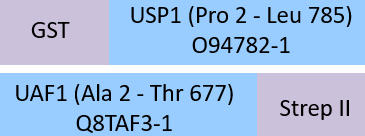
Human USP1 & UAF1 Protein, GST Tag&Strep II Tag

Product Number/Spec
Price
Availability
Menge
US1-H85W3-100ug
$350.00
In Stock - Delivery in 1-2 business days
US1-H85W3-1mg
$2,310.00
In Stock - Delivery in 2-3 weeks
US1-H85W3
Product Amount :
$ 0
0
Add to Cart
New Product Suggestion Request Quote
Contact Us
Contact Us
Product Amount:
$ 0
0
Add to Cart
  • Product Details
  • Data Display
  • Reviews & Citations
  • Important Statement
  • Resources
Synonyms

USP1 & UAF1

Source

Human USP1 & UAF1 Protein, GST Tag&Strep II Tag (US1-H85W3) is expressed from Baculovirus-Insect cells. It contains AA Pro 2 - Leu 785 & Ala 2 - Thr 677 (Accession # O94782-1 & Q8TAF3-1).

Predicted N-terminus: Met & Met

Molecular Characterization

Human USP1 & UAF1 Protein, GST Tag&Strep II Tag, produced by co-expression of USP1 and UAF1, has a calculated MW of 114.1 kDa (USP1) and 77.8 kDa (UAF1). Subunit USP1 is fused with a GST tag at the N-terminus and subunit UAF1 is fused with Strep II-tag at the C-terminus. The protein migrates as 80-95 kDa and 110-130 kDa when calibrated against Star Ribbon Pre-stained Protein Marker under reducing (R) condition (SDS-PAGE) due to glycosylation.

Purity

>95% as determined by SDS-PAGE.

Formulation

Supplied as 0.2 μm filtered solution in 50 mM Tris, 150 mM NaCI, pH7.5 with glycerol as protectant.

Contact us for customized product form or formulation.

Shipping and Storage

This product is supplied and shipped on dry ice.

Please avoid repeated freeze-thaw cycles.

This product is stable after storage at:
  • The product MUST be stored at -70°C or lower upon receipt;
  • -70°C for 3 months under sterile conditions.

Background Introduction

USP1 (ubiquitin‑specific protease 1) is a deubiquitinating enzyme crucial for DNA damage repair, cell cycle regulation, and protein homeostasis. Its catalytic efficiency is markedly enhanced by UAF1 (USP1‑associated factor 1), a cofactor that stabilizes USP1 and directs it to nuclear substrates. Together, the USP1–UAF1 complex removes ubiquitin from key proteins such as PCNA and FANCD2, maintaining genomic stability and influencing cancer development, making it a potential therapeutic target in oncology.