







 COA



- Product Details
- Performance Data
- Reviews & Citations
- Resources
1/2

SEMA4D, C9orf164, CD100, FLJ33485, FLJ34282, FLJ39737, FLJ46484, M-sema-G, MGC169138, MGC169141, SEMAJ, coll-4, Semaphorin-4D
Human Semaphorin 4D Protein, His Tag (CD0-H52H7) is expressed from human 293 cells (HEK293). It contains AA Met 22 - Arg 734 (Accession # Q92854).
Predicted N-terminus: Met 22
This protein carries a polyhistidine tag at the C-terminus.
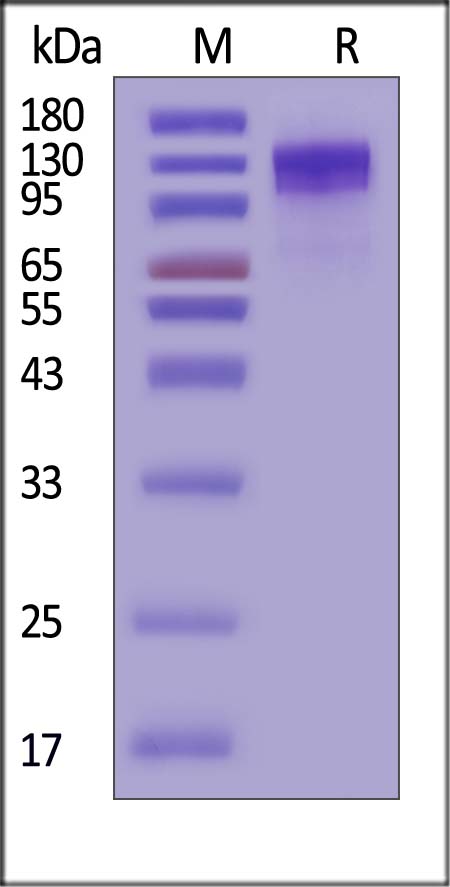
The protein has a calculated MW of 81.0 kDa. The protein migrates as 100-160 kDa when calibrated against Star Ribbon Pre-stained Protein Marker under reducing (R) condition (SDS-PAGE) due to glycosylation.
The protein is designed as a dimer.
Less than 1.0 EU per μg by the LAL method / rFC method.
>90% as determined by SDS-PAGE.
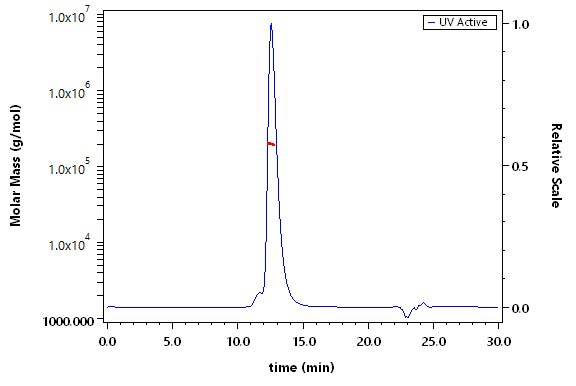
>90% as determined by SEC-MALS.
Lyophilized from 0.22 μm filtered solution in PBS, pH7.4 with trehalose as protectant.
Contact us for customized product form or formulation.
Please see Certificate of Analysis for specific instructions.
For best performance, we strongly recommend you to follow the reconstitution protocol provided in the CoA.
This product is shipped at ambient temperature.
For long term storage, the product should be stored at lyophilized state at -20°C or lower.
Please avoid repeated freeze-thaw cycles.