

GENIUS™Nuclease

Customer Reviews
Cat. No. / Size
Price
Availability
Qty
BEE-N3116-10KU
$110.00
In Stock - Delivery in 2-3 business days
BEE-N3116-50KU
$215.00
In Stock - Delivery in 2-3 business days
BEE-N3116-500KU (250KU X 2)
$955.00
In Stock - Delivery in 2-3 business days

Product Details

  • Product Details

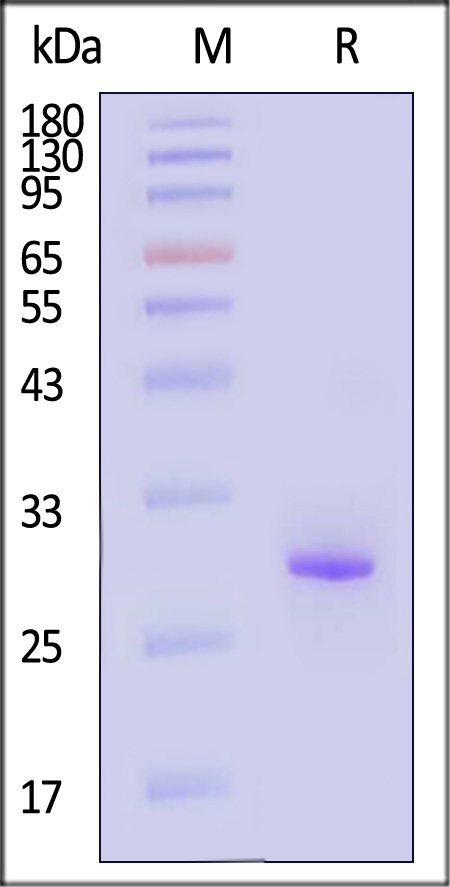
    GENIUS™Nuclease is a recombinant form of Serratia marcescens extracellular endonuclease produced in Escherichia coli cells using a proprietary process at ACROBiosystems. GENIUS™Nuclease is a homodimer with monomer molecular masses about 30 kDa. Two disulfide bonds found in the nuclease are crucial to its activity and stability. The enzyme is a non-specific nuclease with high specific activity, which degrades both single- and double-stranded nucleic acids in any form ( single stranded, double stranded, linear, circular and supercoiled). It hydrolyzes internal phosphodiester bonds present between the nucleotides to 5‘- phosphorylated oligonucleotides of 3-5 bases in length.

  • Features and Advantages

    1. Generally usable: Generally usable for removing all forms of DNA and RNA from biological products, reducing viscosity and preventing cell clumping.
    2. Efficient: Efficient reaction, rapid degradation, reduce processing time.
    3. Native: Native structure, tag free, the enzyme activity is more guaranteed.
    4. Ideal: Ideal for DNA and RNA clearance
    5. Ultra pure: Ultra pure: High purity and activity
    6. Specific: Specific nuclease, no protease activity
  • Application

    Its high intrinsic activity and broad substrate tolerance make the endonuclease an ideal tool in a variety of biotechnological applications: removal of nucleic acid from protein samples ( Elimination of nucleic acids from recombinant proteins; Purification of protein fragments from inclusion bodies; Sample preparation in western blotting or two- dimensional gel electrophoresis) ; Viscosity reduction in protein extracts.

  • Operating Conditions

    GENIUS™Nuclease is functional between pH 6 and 10 (optimal at pH8 - 8.5) , and from 0℃ to 42 ℃ (optimal at 35 ℃ - 42 ℃). Mg2+ (1-2 mM) is required for enzyme activity. 1 mM EDTA reduced the activity by 30% in the presence of 1 mM MgCl2; 0.1 M EDTA eliminated all enzyme activity. In the presence of 1 mM MgCl2, enzyme levels were reduced 75% by 0.1 M CaCl2 or 1 M NaCl. Under standard assay conditions, 1 mM iodoacetate had no effect on the enzymatic rate, whereas 1 mM mercaptoethanol and maleic acid reduced the activity by only 5 to 10%. 10 mM p- Chloromercurybenzoate completely inactivates the enzyme, while 0.64 M beta-mercaptoethanol in the presence of 2 M urea causes only partial inactivation of the enzyme. 4 or 7 M Urea increases the enzyme activity.

  • Unit Definition

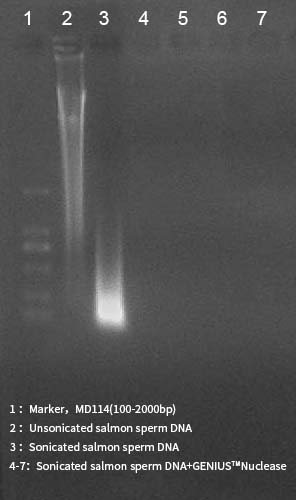
    One unit will digest sonicated salmon sperm DNA to acid-soluble oligonucleotides equivalent to a ΔA260 of 1.0 in 30 min at pH 8.0 at 37 ℃, which corresponds approximately to complete digestion of 37 μg DNA. Note that 1 KU=1000 units.

  • Purity

    >95% as determined by SDS-PAGE.

  • Enzyme Activity

    >250 U/μL

  • Sterility

    Negative

  • Formulation

    Lyophilized from 0.22 μm filtered solution in 20 mM Tris, 20 mM NaCl, 2 mM MgCl2, pH8.0 with trehalose as protectant.

    Contact us for customized product form or formulation.

  • Shipping and Storage

    This product is shipped at ambient temperature.

    This product is stable after storage at:

    1. In lyophilized state for 1 year (-20℃); After reconstitution under sterile conditions for 3 months (-70℃).

Customers Also Viewed

Performance Data

  • Bioactivity

    The result of GENIUS™Nuclease activity.

Customer Reviews
Writing Reviews

FAQ

  • product

    Can lyophilized proteins remain stable during room-temperature shipping or temporary room-temperature exposure?

    In general, lyophilized proteins remain stable during room-temperature shipping or temporary exposure to room-temperature conditions.


    Many ACROBiosystems recombinant proteins are supplied in lyophilized (freeze-dried) form. The lyophilization process effectively removes moisture from the product, helping reduce degradation-related reactions and improve protein stability during transportation and storage.


    To evaluate the stability of lyophilized proteins under normal temperature conditions, ACROBiosystems conducted a stability study on 11 representative lyophilized protein products at 37°C. The study demonstrated that these proteins maintained good quality stability after storage at 37°C for approximately 20 days. Based on these validation results, temporary room-temperature exposure during shipping or handling is generally not expected to have a significant impact on product quality or downstream application performance.


    To ensure optimal long-term stability, products should be stored according to the storage conditions specified in the product Certificate of Analysis (COA) upon receipt.


    Supporting Document


Recent Advances

 
Drug Candidate Licensing
More
  • Basic Product Information
  • Product Details
  • Customers Also Viewed
  • Performance Data
  • Customer Reviews
  • FAQ