

Human CD19 (20-291) Protein, His Tag

AIDD‑Ready
Related Products: Bridging ELISA Kit BIS-A002
Cat. No. / Size
Price
Availability
Qty
CD9-H52H2AI-250ug
$1,890.00
CD9-H52H2AI-500ug (250ug X 2)
$3,020.00
Sub-Total:
$ 0
  • Product Details
  • Performance Data
  • Reviews & Citations
  • Important Statement
  • Resources
Application

Human CD19 (20-291) Protein, His Tag AIDD-Ready protein is designed for direct use in SPR assays. It is supplied in a sugar-free, glycerol-free formulation to eliminate refractive index interference in SPR. No desalting or buffer exchange is required before use, simplifying the SPR workflow and supporting high-throughput experimental validation to accelerate the transition from AI prediction to wet-lab validation.

Features and Advantages
  • Directly compatible with SPR: No desalting or buffer exchange required; supplied as a liquid to reduce sample preparation and improve experimental efficiency.
  • High batch-to-batch consistency: Each lot is released using SPR QC to ensure experimental reproducibility.
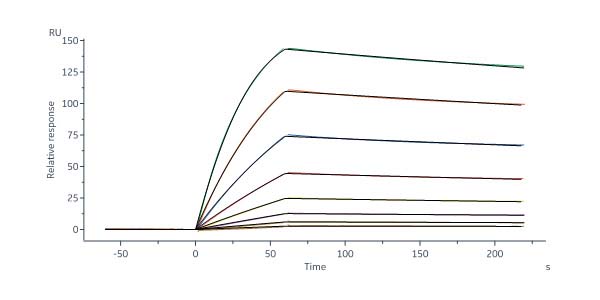
  • Validated with representative drugs: SPR binding activity is validated using representative drug antibodies to ensure suitability for drug screening and evaluation.
Synonyms

CD19, B4, CVID3, MGC12802

Source

Human CD19 (20-291) Protein, His Tag (CD9-H52H2AI) is expressed from human 293 cells (HEK293). It contains AA Glu 21 - Lys 291 (Accession # P15391-1).

Predicted N-terminus: Glu 21

Molecular Characterization

This protein carries a polyhistidine tag at the C-terminus.

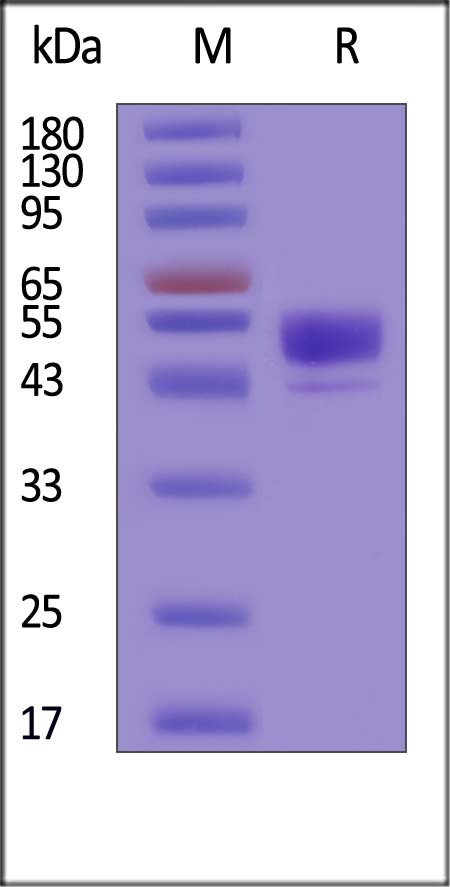
The protein has a calculated MW of 31.9 kDa. The protein migrates as 43 kDa and 45-60 kDa when calibrated against Star Ribbon Pre-stained Protein Marker under reducing (R) condition (SDS-PAGE) due to glycosylation.

Purity

>90% as determined by SDS-PAGE.

Formulation

Formulated in a proprietary trehalose-free buffer, supplied ready-to-use for SPR/BLI analysis - no buffer exchange required.

For detailed formulation, please refer to the batch-specific COA.

Shipping and Storage

This product is supplied and shipped on dry ice.

Please avoid repeated freeze-thaw cycles.

This product is stable after storage at:
  • The product MUST be stored at -70°C or lower upon receipt;
  • -70°C for 12 months under sterile conditions.

Background

B-lymphocyte antigen CD19 is also known as CD19 (Cluster of Differentiation 19), is a single-pass type I membrane protein which contains two Ig-like C2-type (immunoglobulin-like) domains. CD19 is expressed on follicular dendritic cells and B cells. In fact, it is present on B cells from earliest recognizable B-lineage cells during development to B-cell blasts but is lost on maturation to plasma cells. It primarily acts as a B cell co-receptor in conjunction with CD21 and CD81. Upon activation, the cytoplasmic tail of CD19 becomes phosphorylated, which leads to binding by Src-family kinases and recruitment of PI-3 kinase. As on T cells, several surface molecules form the antigen receptor and form a complex on B lymphocytes. The (almost) B cell-specific CD19 phosphoglycoprotein is one of these molecules. The others are CD21 and CD81. These surface immunoglobulin (sIg)-associated molecules facilitate signal transduction. On living B cells, anti-immunoglobulin antibody mimicking exogenous antigen causes CD19 to bind to sIg and internalize with it. The reverse process has not been demonstrated, suggesting that formation of this receptor complex is antigen-induced. This molecular association has been confirmed by chemical studies. Mutations in CD19 are associated with severe immunodeficiency syndromes characterized by diminished antibody production. CD19 has been shown to interact with: CD81, CD82, Complement receptor 2, and VAV2.

ACRO Scientific Leadership Award

Supporting the scientists driving cell & gene therapy forward

Apply Now