


Biotinylated Human CD133 Protein, His,Flag&Avitag™ (Nanodisc)

Customer Reviews
Cat. No. / Size
Price
Availability
Qty
CD3-H82D4-20ug
$1955.00
In Stock - Delivery in 2-3 weeks
CD3-H82D4-100ug
$5870.00
In Stock - Delivery in 2-3 weeks

Product Details

  • Application

    1. Cell based assay (FACS or functional assay)
    2. Affinity testing (SPR / BLI)
    3. Screening (ELISA)
  • Synonyms

    CD133, PROM1, PROML1, Prominin-1, AC133

  • Source

    Nanodisc Biotinylated Human CD133 Protein, His,Flag&Avitag (CD3-H82D4) is expressed from human 293 cells (HEK293). It contains AA Gly 20 - His 865 (Accession # O43490-1).

    Predicted N-terminus: Gly 20

    Request for sequence
  • Molecular Characterization

    CD133 Structure

    Other Tags and Version Biotin & Other Labeled Version

    This protein carries a polyhistidine tag and a Flag tag at the C-terminus, followed by an Avi tag (Avitag™).

    The protein has a calculated MW of 100.6 kDa. The protein migrates as 25 kDa and 95-130 kDa when calibrated against Star Ribbon Pre-stained Protein Marker under reducing (R) condition (SDS-PAGE) due to glycosylation.

    *The isotype control of empty/mock nanodisc (Cat. No. APO-H81Q5) is sold separately and not included in protein, you can follow the link for product information.
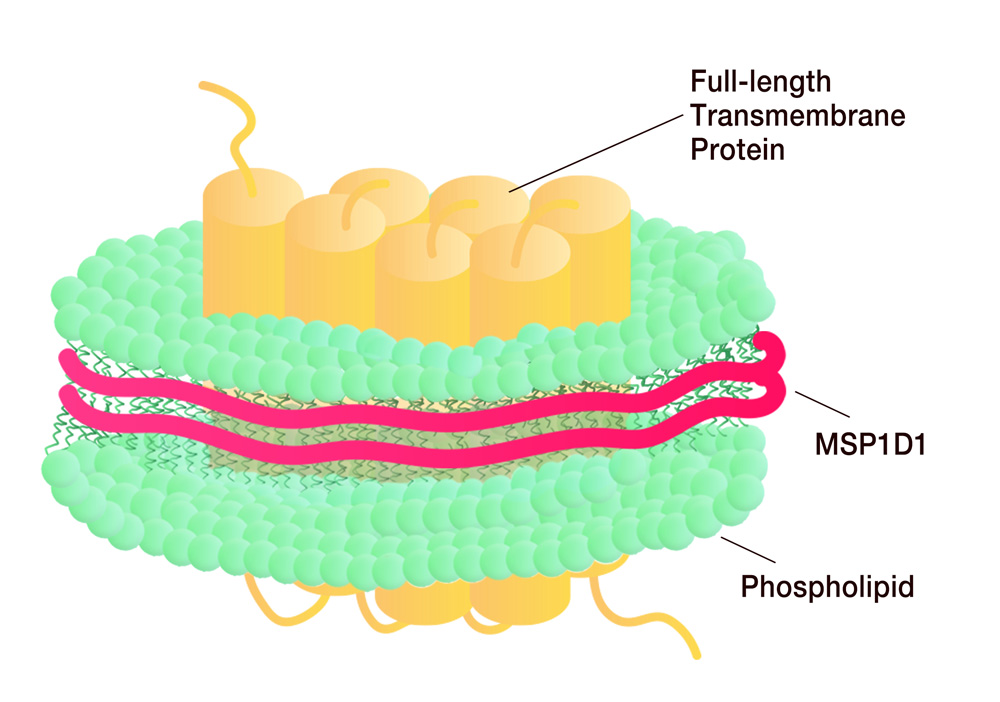
    1. Structure

      Nanodisc membrane protein is wrapped by a synthetic phospholipid bilayer membrane structure, composed of membrane scaffold proteins (MSPs) and phospholipids.

    2. Synthesis Process

      Nanodisc reconstitution is a self-assembly process that starts from purified, detergent-solubilized membrane proteins and reconstitutes them into synthetic phospholipid bilayers stabilized by MSP1D1 membrane scaffold protein. This creates a stable, detergent-free environment that preserves native conformation and biological activity, with excellent homogeneity and full compatibility with cell-based assays such as FACS and binding assays in antibody discovery and screening (ELISA),etc.

  • Labeling

    Biotinylation of this product is performed using Avitag™ technology. Briefly, the single lysine residue in the Avitag is enzymatically labeled with biotin.

  • Protein Ratio

    Passed as determined by the SABA assay / HABA assay / binding ELISA.

  • Purity

    >80% as determined by SDS-PAGE.

  • Formulation

    Supplied as 0.2 μm filtered solution in 20 mM HEPES, 150 mM NaCl, pH7.5 with trehalose as protectant.

    Contact us for customized product form or formulation.

  • Shipping and Storage

    This product is supplied and shipped on dry ice.

    Please avoid repeated freeze-thaw cycles.

    This product is stable after storage at:

    1. The product MUST be stored at -70°C or lower upon receipt;
    2. -70°C for 12 months under sterile conditions.
  • ACRO Quality Management System

    1. QMS(ISO, GMP)
    2. Quality Advantages
    3. Quality Control Process

Customers Also Viewed

Performance Data

  • SDS-PAGE

    CD133 SDS-PAGE

    Biotinylated Human CD133 Protein, His,Flag&Avitag on SDS-PAGE under reducing (R) condition. The gel was stained with Coomassie Blue. The purity of the protein is greater than 80% (With Star Ribbon Pre-stained Protein Marker).

  • Bioactivity-ELISA

     CD133 ELISA

    Immobilized Biotinylated Human CD133 Protein, His,Flag&Avitag (Cat. No. CD3-H82D4) at 1 μg/mL (100 μL/well) on streptavidin (Cat. No. STN-N5116) precoated (0.5 μg/well) plate can bind Monoclonal Anti-Human CD133 Antibody, Human IgG1 (AM76) with a linear range of 0.1-13 ng/mL (QC tested).

    Protocol
  • Bioactivity-SPR

     CD133 SPR

    Biotinylated Human CD133 Protein, His,Flag&Avitag (Cat. No. CD3-H82D4) immobilized on SA Chip can bind Monoclonal Anti-Human CD133 Antibody, Human IgG1 with an affinity constant of 1.05 nM as determined in a SPR assay (Biacore 8K) (Routinely tested).

    Protocol

Customer Reviews
Writing Reviews

Background

CD133 (Prominin-1), a pentaspan membrane glycoprotein marking cancer stem cells (CSCs) in glioblastoma, colorectal, and liver cancers. CD133+ cell populations exhibit enhanced tumor initiation, chemoresistance, and self-renewal capacity. It is a critical target for eradicating the CSC niche to prevent tumor relapse and metastasis.

Recent Advances

 
Drug Development Progress
  • English Name:

    CD133

  • Category:

  • Approved Drugs:

    0 Details

  • Drugs in Clinical Trials:

    2 Details

  • Highest Development Stage:

    Phase 2 Clinical

Drug Candidate Licensing
More
  • Basic Product Information
  • Product Details
  • Customers Also Viewed
  • Performance Data
  • Customer Reviews
  • Background