

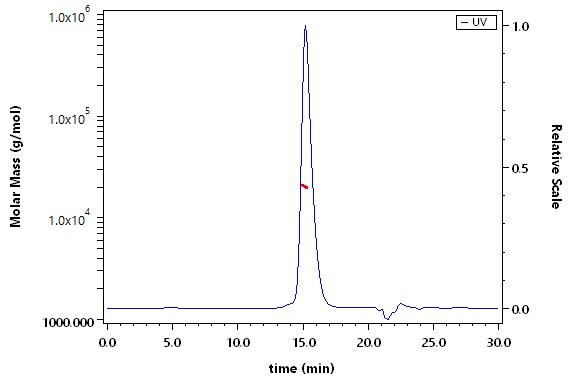

Human ALK-1 / ACVRL1 Protein, His Tag, low endotoxin (MALS verified)

AIDD‑Ready
Cat. No. / Size
Price
Availability
Qty
AL1-H5228-100ug
$295.00
In Stock - Delivery in 1-2 business days
AL1-H5228-1mg
$2,040.00
In Stock - Delivery in 1-2 business days
Sub-Total:
$ 0
  • Product Details
  • Performance Data
  • Reviews & Citations
  • Important Statement
  • Resources
Synonyms

ACVRL1, ACVRLK1, ALK-1, HHT, HHT2, ORW2, SKR3, TSR-I

Source

Human ALK-1, His Tag (AL1-H5228) is expressed from human 293 cells (HEK293). It contains AA Asp 22 - Gln 118 (Accession # P37023).

Predicted N-terminus: Asp 22

Molecular Characterization

This protein carries a polyhistidine tag at the C-terminus.

The protein has a calculated MW of 12.6 kDa. The protein migrates as 23-28 kDa when calibrated against Star Ribbon Pre-stained Protein Marker under reducing (R) condition (SDS-PAGE) due to glycosylation.

Endotoxin

Less than 0.01 EU per μg by the LAL method / rFC method.

Purity

>95% as determined by SDS-PAGE.

>95% as determined by SEC-MALS.

Formulation

Lyophilized from 0.22 μm filtered solution in PBS, pH7.4 with trehalose as protectant.

Contact us for customized product form or formulation.

Reconstitution

Please see Certificate of Analysis for specific instructions.

For best performance, we strongly recommend you to follow the reconstitution protocol provided in the CoA.

Shipping and Storage

This product is shipped at ambient temperature.

For long term storage, the product should be stored at lyophilized state at -20°C or lower.

Please avoid repeated freeze-thaw cycles.

This product is stable after storage at:
  • -20°C to -70°C for 12 months in lyophilized state;
  • -70°C for 3 months under sterile conditions after reconstitution.

Background

Serine/threonine-protein kinase receptor R3 is an enzyme that in humans is encoded by the ALK1 gene. ALK1 is a receptor in the TGF beta signaling pathway. ALK1 protein is a receptor in the TGF beta signaling pathway. It plays an important role in vascular development, remodeling, and pathologic angiogenesis, play a role in stabilizing angiogenic vessels and contribute to resistance to anti-VEGF therapies, ALK1 blockade may represent an effective therapeutic opportunity complementary to the current antiangiogenic modalities in the clinic. Recently, researcher found that, ALK1-Fc inhibited BMP9-mediated Id-1 expression in human umbilical vein endothelial cells and inhibited cord formation by these cells on a Matrigel substrate, in a chick chorioallantoic membrane assay, ALK1-Fc reduced vascular endothelial growth factor-, fibroblast growth factor-, and BMP10-mediated vessel formation, and ALK1-Fc treatment reduced tumor burden in mice receiving orthotopic grafts of MCF7 mammary adenocarcinoma cells.