Q1: Because the molecular weight of the Fc on the two isoforms of
CDD-H5255 (Human CD3 epsilon and CD3 delta heterodimer protein, Fc Tag & Fc Tag) are so similar, how can you confirm that
CDD-H5255 is a real heterodimer?
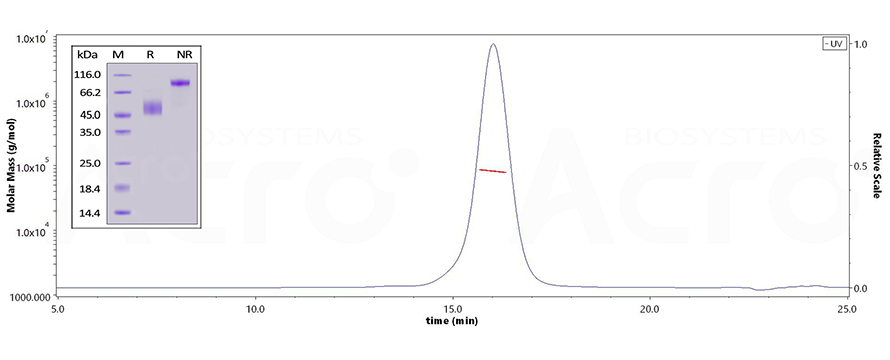
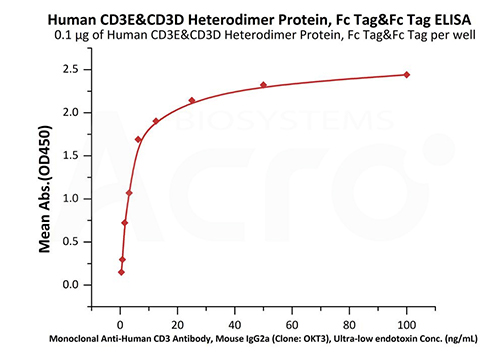
A1: We have specially designed this product to ensure that CD3E and CD3D form a heterodimer which is verified through two different aspects: structure and activity. The structure is verified through SEC-MALS and reducing / non-reducing electrophoresis. On the other hand, activity is verified through binding activity to our CD3 antibody, OKT3. OKT3 only recognizes CD3 epsilon in CD3E&CD3D, therefore confirming that CD-H5255 is a real, active heterodimer.
CD3E&CD3D (Cat. No.
CDD-H5255) is 1:1 heterodimer as verified by non-reducing electrophoresis and MALS.
CD3E&CD3D (Cat. No.
CDD-H5255) can specifically bind to Monoclonal Anti-Human CD3 Antibody, Mouse IgG2a (Clone: OKT3), as verified by ELISA.
Q3: I found that some CD3 products are listed as offline. What does this mean?
A3: Our offline products are products that have been updated with newer, updated products. Our newer products have been further optimized to improve factors such as purity and activity. For example, some of our offline products include and Online versions of these products are CDE-H8224 (MALS verified heterodimer purity> 90%), CDD-H82W6 (MALS-verified heterodimer purity>85%), CDD-H52W1 (MALS-verified heterodimer>85%; better binding activity to OKT3) respectively. If you cannot find the corresponding online product to your offline one, please feel free to contact us.
Q4: Is the CD3 protein lyophilized? Has the protein been functionally tested after lyophilization?
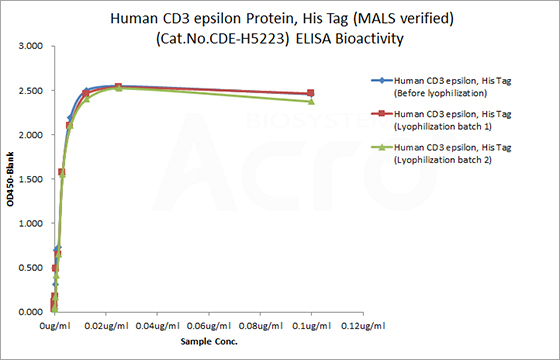
A4: Yes, our CD3 proteins are lyophilized. Functional testing of our proteins is performed before and after lyophilization.
Different lyophilized batches of Human CD3 epsilon Protein, His Tag (MALS verified) (Cat. No.
CDE-H5223) have the same biological activity as the product before lyophilization, with high consistency and verified by ELISA.
Q5: Does CD3 proteins contain BSA?
A5: No. We use trehalose as a protective agent to exclude animal-derived interferences.
Q6: I want to confirm if the Fc tag in CD3E is human IgG1 or mouse IgG1?
A6: The Fc tag is human IgG1. If the species of the Fc tag is unlisted, it can be assumed that our Fc-tagged proteins carry human IgG Fc-tag.
Q7: When selecting and using Fc-tagged CD3E&CD3D and CD3E&CD3G heterodimeric proteins for establishing antibody binding verification methods, what are some potential issues that should be considered when selecting chromogenic secondary antibodies?
A7: One issue to take into consideration is the cross-reactivity between anti-human IgG Fc antibody / llama IgG Fc tags, and anti-llama IgG Fc antibody / human IgG Fc tag. When using the Fc-tagged CD3 antigen to verify antibody binding activity, careful selection of the chromogenic secondary antibody is critical to avoid cross-reactivity.




 Aug 18, 2022
 Page Views:9585