

Cat. No. / Size
Price
Availability
Qty
CTF-H5113-100ug
$310.00
CTF-H5113-1mg
$2,040.00
Sub-Total:
$ 0
  • Performance Data
  • Reviews & Citations
  • Important Statement
  • Resources
  • 分子别名(Synonym)

    CCN2,NOV2,HCS24,IGFBP8,IBP-8,IGFBP-8,IGF-binding protein 8

  • 表达区间及表达系统(Source)

    Human CTGF Protein, Tag Free (CTF-H5113) is expressed from E. coli cells. It contains AA Gly 253 - Ala 349 (Accession # Q5M8T4-1 ).

    Predicted N-terminus: Met

    Request for sequence
  • 蛋白结构(Molecular Characterization)

    CTGF Structure

    This protein carries no "tag".

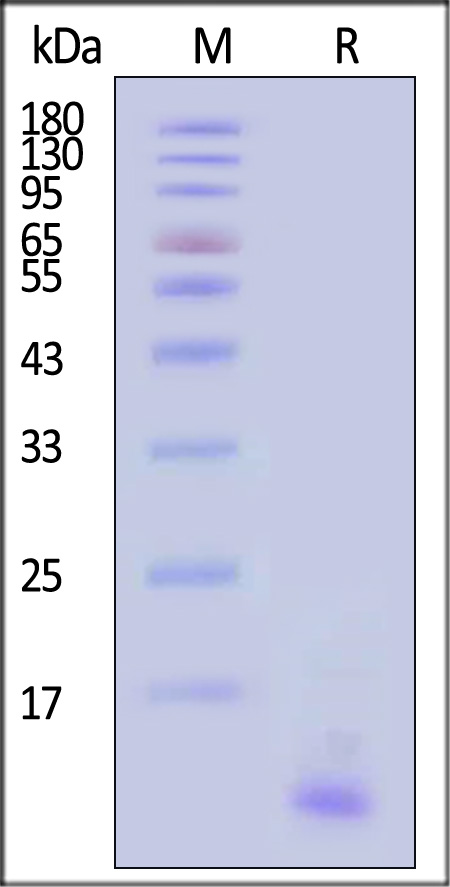
    The protein has a calculated MW of 11.2 kDa. The protein migrates as 10-11 kDa when calibrated against Star Ribbon Pre-stained Protein Marker under reducing (R) condition (SDS-PAGE).

  • 内毒素(Endotoxin)

    Less than 0.1 EU per μg by the LAL method / rFC method.

  • 纯度(Purity)

    >95% as determined by SDS-PAGE.

  • 制剂(Formulation)

    Supplied as 0.2 μm filtered solution in PBS, pH7.4 with glycerol as protectant.

    Contact us for customized product form or formulation.

  • 运输(Shipping)

    This product is supplied and shipped with dry ice, please inquire the shipping cost.

  • 存储(Storage)

    Please avoid repeated freeze-thaw cycles.

    This product is stable after storage at:
    1. The product MUST be stored at -70°C or lower upon receipt;
    2. -70°C for 3 months under sterile conditions.
  • 质量管理控制体系(QMS)

    1. 质量管理体系(ISO, GMP)
    2. 质量优势
    3. 质控流程

Background

Connective Tissue Growth Factor (CTGF), also known as CCN2, is a member of the CCN (CCN1-6) family of modular matricellular proteins. Like other CCN proteins, mature human CTGF consists of IGF-binding protein domain, a vWF-C domain, a TSP-1 domain, and a cysteine knot heparin-binding domain. CTGF promotes proliferation and differentiation of chondrocytes. Mediates heparin- and divalent cation-dependent cell adhesion in many cell types including fibroblasts, myofibroblasts, endothelial and epithelial cells. Enhances fibroblast growth factor-induced DNA synthesis. Analysis of CCN2 function in vivo has focused primarily on its key role as a mediator of excess ECM synthesis in multiple fibrotic diseases.