



 COA
COA


- Product Details
- Performance Data
- Reviews & Citations
- Resources
1/5
Items | Details |
Detection Method | Chemiluminescence |
Product Type | Magnetic Beads (Streptavidin) |
Quantity Size | 10mg / 100mg |
Physical Appearance | lyophilized powder mixture |
Particle size | 2.8µm |
Beads Surface | Hydrophilic |
Binding Capacity | 5-20 μg biotinylated proteins or molecules / mg Beads |
Emission Wavelength | Measured relative light units (RLU) at 430 nm |
The Streptavidin-Magnetic Beads are 2.8 µm superparamagnetic particles covalently coupled to a highly pure form of streptavidin (SA). The beads can be used to capture the biotinylated proteins or other molecules, because Streptavidin (SA) has an extraordinarily high affinity for biotin with a dissociation constant (Kd) on the order of 10−14 mol/L, the Biotinylated molecules can bind to the SA irreversibly.
Streptavidin is a tetrameric protein purified from the bacterium Streptomyces avidin, and exhibits high binding affinity for biotin. Able to bind one molecule of biotin with each subunit. Streptavidin (PI=6.0-7.5) has lower level of non-specific binding to various biological components at physiological pH than avidin (PI=7.4), resulting from its isoelectric point (PI).
The Streptavidin-Magnetic Beads is easy to capture the biotinylated proteins or other molecules in Chemiluminescence procedures, and the bounded protein have no activity lost, this ready to use products could greatly save your protein coupling time and hassle, and help us get the best performance and highly reproducible results.
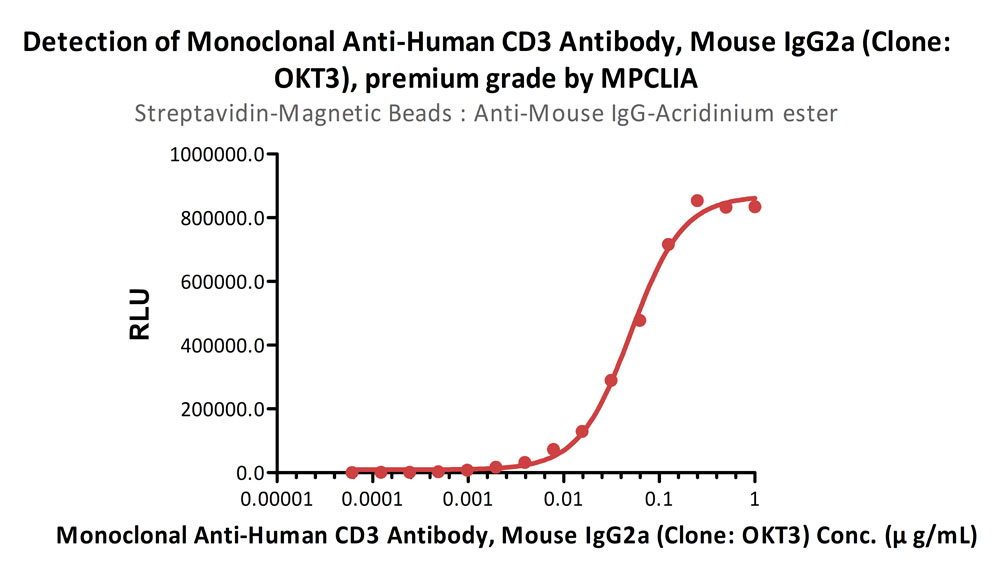
The Streptavidin-Magnetic Beads is used to capture the biotinylated proteins or other molecules, it can combination with Acridinium ester markers but not Streptavidin Acridinium ester in chemiluminescence technology, The Acridinium ester markers such as Anti-Mouse IgG or Anti-human IgG-Acridinium ester can capture the antibodies, this allows detection of antigen and antibody binding or antibody screening.
See Certificate of Analysis (CoA) for detailed instruction.
Upon receipt, please store the Beads at -20°C. The shelf life is 1 year at -20 °C.
Please avoid more than 3 freeze-thaw cycles once reconstitution, immediate use after reconstitution is highly recommended.