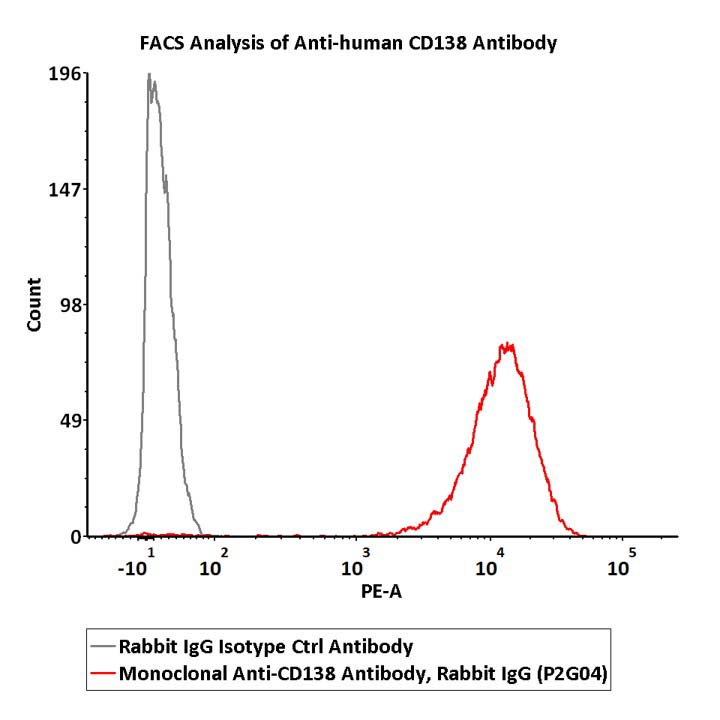


Monoclonal Anti-CD138 Antibody, Rabbit IgG (P2G04)

Cat. No. / Size
Price
Availability
Qty
CD8-MY2574a-25ug
$55.00
CD8-MY2574a-200ug
$320.00
Sub-Total:
$ 0
  • Product Details
  • Performance Data
  • Reviews & Citations
  • Important Statement
  • Resources
Source

Monoclonal Anti-CD138 Antibody, Rabbit IgG (P2G04) is recombinantly expressed from human 293 cells (HEK293), which provides higher batch consistency and long term security of supply.

Antibody Type

Recombinant Monoclonal

Clone

P2G04

Isotype

Rabbit IgG, Kappa

Host Species

Rabbit

Reactivity

Human

Immunogen

Recombinant Human CD138 is expressed from human 293 cells

Specificity

Specifically recognizes Human CD138 Protein.

Application

Flow Cytometry (Evaluation of the expression of CD138 on Human cells).

Form

Lyophilized

Formulation

Lyophilized from a 0.22 μm-filtered solution in PBS (pH 7.4), with trehalose as protectant.

Please contact us for customized product forms or formulations.

Reconstitution

Please refer to the Certificate of Analysis (CoA) for specific instructions.

Shipping

Lyophilized product is shipped at ambient temperature.

Storage

For long term storage, the product should be stored at lyophilized state at -20°C or lower.

Please avoid repeated freeze-thaw cycles.

This product is stable after storage at:
  • -20°C to -70°C for 12 months in lyophilized state;
  • -70°C for 3 months under sterile conditions after reconstitution.
Notices

Product Specific Notices: For research use only.

Background

Syndecan-1 (SYND1 or SDC1) is also known as CD antigen CD138, is a transmembrane (type I) heparan sulfate proteoglycan and is a member of the syndecan proteoglycan family. The syndecans mediate cell binding, cell signaling, and cytoskeletal organization and syndecan receptors are required for internalization of the HIV-1 tat protein. The syndecan-1 / SDC1 protein functions as an integral membrane protein and participates in cell proliferation, cell migration and cell-matrix interactions via its receptor for extracellular matrix proteins. It is a useful marker for plasma cells, but only if the cells tested are already known to be derived from blood.