


This product is in development. If you are interested in this product, please contact us directly. We will accelerate our R&D process according to your needs and reserve the product for you.
Cat. No. / Size
Price
Availability
Qty
PGF-H52G3-20ug
$300.00
PGF-H52G3-500ug
$1,650.00
Sub-Total:
$ 0
  • Performance Data
  • Reviews & Citations
  • Important Statement
  • Resources
  • Synonyms

    PGF, PLGF, PlGF, PGFL, SHGC-10760

  • Source

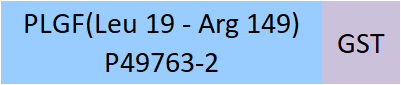
    Human PLGF (19-144) Protein, GST Tag (PGF-H52G3) is expressed from human 293 cells (HEK293). It contains AA Leu 19 - Arg 149 (Accession # P49763-2).

    Predicted N-terminus: Leu 19
  • Molecular Characterization

    PLGF Structure

    Other Tags and Version Biotin & Other Labeled Version

    This protein carries a GST tag at the C-terminus.

    The protein has a calculated MW of 41.0 kDa. The protein migrates as 45-55 kDa under reducing (R) condition (SDS-PAGE) due to glycosylation.

  • Endotoxin

    Less than 1.0 EU per μg by the LAL method / rFC method.

  • Purity

    >95% as determined by SDS-PAGE.

  • Formulation

    Please contact us for detailed information.

    Contact us for customized product form or formulation.

  • Reconstitution

    Please see Certificate of Analysis for specific instructions.

    For best performance, we strongly recommend you to follow the reconstitution protocol provided in the CoA.

  • Storage

    For long term storage, the product should be stored at lyophilized state at -20°C or lower.

    Please avoid repeated freeze-thaw cycles.

    This product is stable after storage at:

    1. -20°C to -70°C for 12 months in lyophilized state;
    2. -70°C for 3 months under sterile conditions after reconstitution.
  • ACRO Quality Management System

    1. QMS(ISO, GMP)
    2. Quality Advantages
    3. Quality Control Process

Background

Placental growth factor (PGF) is also known as vascular endothelial growth factor-related protein, PLGF and PlGF2, is a member of the VEGF (vascular endothelial growth factor) sub-family - a key molecule in angiogenesis and vasculogenesis, in particular during embryogenesis. The main source of PGF during pregnancy is the placental trophoblast. PGF is also expressed in many other tissues, including the villous trophoblast. PGF is actived in angiogenesis and endothelial cell growth, stimulating their proliferation and migration. PlGF2 binds NRP1/neuropilin-1 and NRP2/neuropilin-2 in a heparin-dependent manner. Also promotes cell tumor growth.